In Brief
Stoicism is a school of philosophy founded in Athens around 300 BCE by Zeno of Citium, which teaches that a good life comes from virtue and from judging events clearly, not from wealth, status, or luck. Its central idea is simple to state and hard to practice: some things are up to us and some are not, and peace of mind depends on caring about the first and accepting the second.
The Stoics were not trying to make people numb or emotionless. They wanted people to see situations accurately, act well, and stay steady when things go wrong. That practical aim is why their books are still read nearly two thousand years later, by soldiers, students, athletes, parents, and anyone trying to stay calm under pressure.
Stoicism at a Glance
The table below gives the basic facts most readers look for first.
| Question | Answer |
|---|---|
| Founded | Around 300 BCE, in Athens |
| Founder | Zeno of Citium |
| Name comes from | The Stoa Poikile, or Painted Porch, where Zeno taught |
| Best-known Stoics | Seneca, Epictetus, Marcus Aurelius |
| Central idea | Separate what is up to you from what is not |
| Goal | Eudaimonia, a flourishing life, reached through virtue |
| Four virtues | Wisdom, justice, courage, temperance |
| Key texts that survive | Seneca’s letters and essays, Epictetus’s Discourses and Enchiridion, Marcus Aurelius’s Meditations |
Where Stoicism Came From
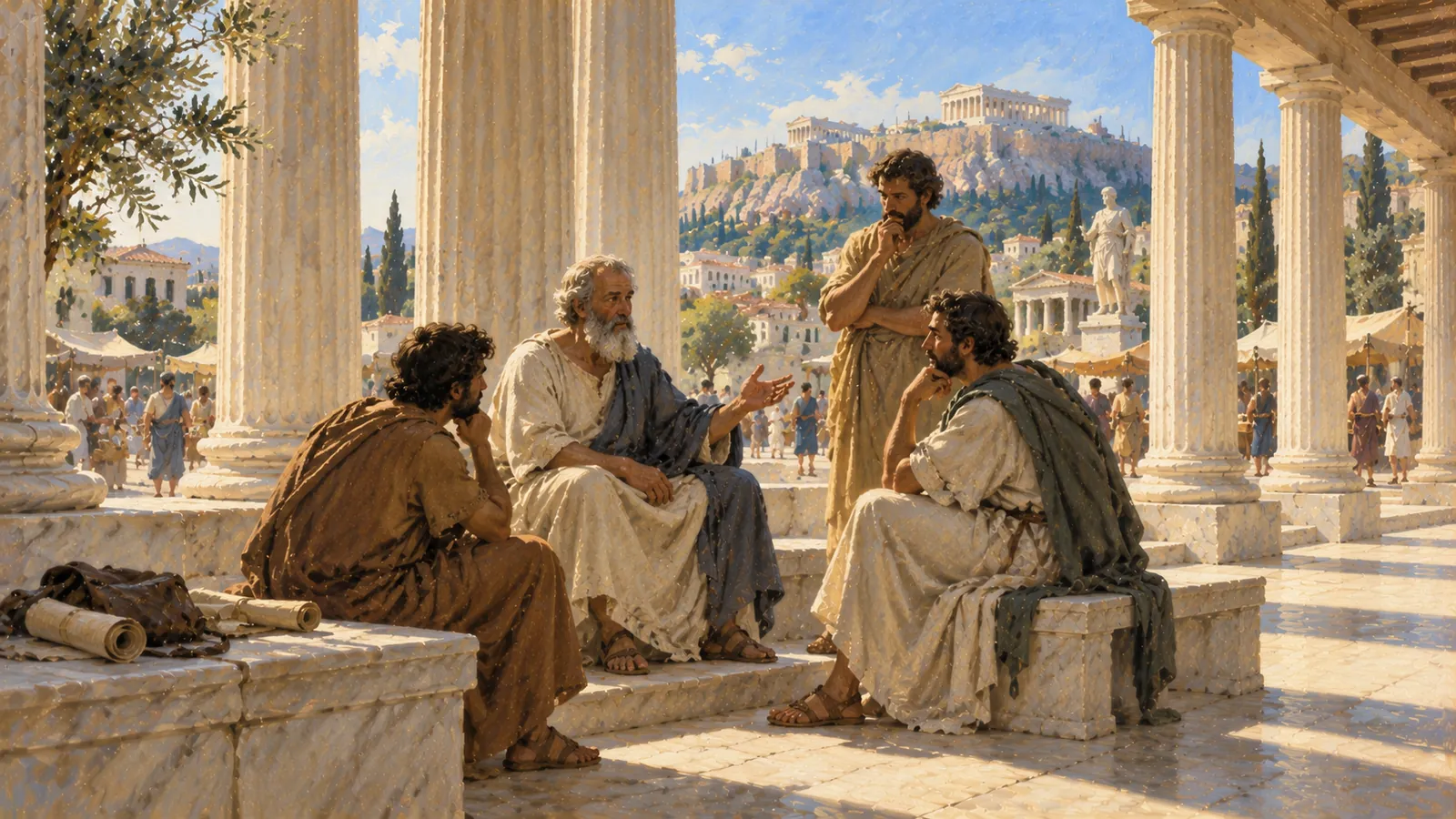
Stoicism began in Athens around 300 BCE, when Zeno of Citium started teaching in a public colonnade on the edge of the agora. The colonnade was called the Stoa Poikile (the Painted Porch) and his students became known as Stoics, after the Greek word stoa, a porch or colonnade.
Zeno drew on Socrates, who taught that virtue is the one thing a person needs to live well, and on the Cynics, who lived simply and mocked social convention. After Zeno, the school was led by Cleanthes and then Chrysippus, who developed and systematized Stoic logic, physics, and ethics. Almost none of their writing survives, apart from Cleanthes’ Hymn to Zeus, so most of what we know about them comes from later summaries.
Did Zeno Call Himself a Stoic?
Zeno did not call himself a Stoic. According to Diogenes Laertius, his followers were at first called Zenonians, after Zeno himself, and only later Stoics, after the colonnade where they met. Zeno knew he was founding a school of his own, but the name “Stoic” was a label others gave it.
He also knew he was teaching something new. In the ancient world, starting a school meant breaking away from your teachers, and Zeno did so after years as a student of several of them. What made his teaching different was the combination: he took the demanding ethics of the Cynics, who held that virtue is all a person needs, and set it inside a full system of logic and physics, subjects the Cynics had little time for.
How Zeno Came to Philosophy
The traditional story is that Zeno was a merchant from Citium, on Cyprus, who came to Athens after a shipwreck. Waiting in a bookshop, he read Xenophon’s memoir of Socrates and asked where men like that could be found. The bookseller pointed to Crates the Cynic, who was passing by, and Zeno became his student. The story comes from Diogenes Laertius, who wrote around five hundred years later, so it is best read as tradition rather than established fact.
Zeno’s Influences
None of Zeno’s teachers were Stoics, since the school did not yet exist. Ancient sources name several teachers and schools that shaped him.
| Influence | School | What Zeno took from it |
|---|---|---|
| Crates of Thebes | Cynic | Simple living and virtue as the only good |
| Socrates, through his followers’ writings | Before these schools | Virtue as knowledge and the examined life |
| Stilpo | Megarian | Calm indifference to fortune, and logic |
| Diodorus Cronus | Dialectician | Logic and argument |
| Xenocrates and Polemo | Plato’s Academy | Living in agreement with nature, within a structured system |
| Heraclitus, who died long before | Early Greek philosopher | A universe ordered by reason, or logos, and by fire |
The Stoic system was then built out by Zeno’s successors. Chrysippus did so much of that work that an ancient saying, preserved by Diogenes Laertius, held that without Chrysippus there would have been no Stoa.
The Roman Stoics
The Stoic writings people actually read today come from the Roman era. Seneca, a statesman and adviser to the emperor Nero, wrote letters and essays on grief, anger, and the shortness of life. Epictetus, who was born enslaved and later freed, taught in Greece; his student Arrian wrote down his lectures as the Discourses and condensed them into a short handbook, the Enchiridion. Marcus Aurelius, Roman emperor from 161 to 180 CE, kept a private notebook of Stoic reminders that we now call the Meditations.
These three wrote for practical use. Seneca writes as a friend giving advice, Epictetus as a demanding teacher, and Marcus Aurelius as a man reminding himself how to behave.
The Core Ideas of Stoicism
Stoicism rests on a handful of ideas that connect to one another. Each of them gets its own page on this site; this section gives the short version.
Some Things Are Up to Us, Some Are Not
The first line of the Enchiridion states an idea that runs through much of later Stoic practice, especially the teaching of Epictetus.
Of things some are in our power, and others are not. In our power are opinion, movement towards a thing, desire, aversion, turning from a thing; and in a word, whatever are our acts.
Epictetus, Enchiridion 1, trans. George Long
Our judgments, intentions, and actions are ours. Epictetus counts our body, property, and reputation as not in our power, along with whatever is not our own act, which includes the behavior of other people. Modern writers call this the dichotomy of control. Treating the second group as if it were the first, Epictetus says, is what makes people disturbed and bitter.
We Are Upset by Our Judgments, Not by Events
The Stoics noticed that two people can face the same event and react in opposite ways. The difference lies in how each of them interprets it.
Men are disturbed not by the things which happen, but by the opinions about the things
Epictetus, Enchiridion 5, trans. George Long
This does not mean bad things are imaginary. It means that the extra layer of misery we add, the story that something is a disaster or an insult, is a judgment, and judgments can be examined and changed.
Virtue Is the Only True Good
For the Stoics, wealth, health, and reputation are not good or bad in themselves. A rich person can be cruel and a poor person can be admirable. What makes a life good is character, which the Stoics described through four virtues: wisdom, justice, courage, and temperance. Marcus Aurelius gives “prudence, temperance, justice, fortitude” as examples of things that are truly good (Meditations 5.12).
The Stoics still preferred health to sickness and enough money to poverty. They called these things “preferred indifferents”: worth choosing, but never worth giving up your character for.
Live in Agreement with Nature
The Stoics described the goal of life as living in agreement with nature. For human beings, that means living according to reason and as social creatures who belong to one human community. Marcus Aurelius returns to this idea often, reminding himself that people are made to work together.
What Stoicism Is Not
The everyday word “stoic,” spelled with a lowercase s, means someone who endures hardship without showing feeling. That meaning grew out of the philosophy, but it misleads in three ways.
First, Stoicism is not about suppressing emotion. The Stoics wanted to avoid destructive passions such as rage and panic, which they saw as based on false judgments, but they valued what they called good feelings, such as joy and goodwill toward others.
Second, Stoicism is not passive acceptance. Marcus Aurelius ran an empire and led armies while writing his notes. Accepting what you cannot control is meant to free your energy for what you can.
Third, Stoicism is not cold self-interest. Justice, care for other people, and duty to the community sit at the center of Stoic ethics.
Why People Still Read the Stoics
Stoicism survives because it is practical. Its texts are short, direct, and full of exercises a reader can try the same day: preparing in the morning for difficult people, reviewing the day at night, and asking, when something stings, whether it is actually up to you.
Modern readers often meet the Stoics through situations, not theory: a harsh comment at work, a stranger who stares on the street, a setback that feels unfair. The ancient question is the same each time. What is happening, what is my judgment about it, and what is the right thing for me to do now?
How to Start Learning Stoicism
The best way to learn Stoicism is to read a little of the original texts and try one practice at a time. The Enchiridion takes under an hour to read and gives the core of Epictetus’s practical teaching in compressed form. The Meditations is better read slowly, a few sections a day. Seneca’s letters work well one at a time, like advice from a friend.
On this site, the Start Here path walks through the essentials in order: this page, the four virtues, the dichotomy of control, how to read the Enchiridion and the Meditations, and a fourteen-day practice. Read Next: The Four Stoic Virtues.
Frequently Asked Questions
The answers below cover the questions readers ask most often about Stoicism.
Who Founded Stoicism?
Zeno of Citium founded Stoicism in Athens around 300 BCE. He taught in the Stoa Poikile, the Painted Porch, which gave the school its name.
What Is the Main Idea of Stoicism?
The main idea is that some things are up to us, our judgments and actions, and others are not, such as other people, our reputation, and events. A good life comes from virtue and from focusing on what is up to us.
Is Stoicism a Religion?
Stoicism is a philosophy, not a religion, although the ancient Stoics believed the universe is ordered by a rational principle they sometimes called God or Zeus. Today, people of many faiths, and of none, practice Stoic ideas.
Do Stoics Have No Emotions?
No. The Stoics tried to avoid emotions based on false judgments, such as uncontrolled anger, but they valued good feelings like joy and kindness. The idea of the emotionless stoic comes from the modern everyday word, not the ancient philosophy.
What Should I Read First?
Start with the Enchiridion of Epictetus, which is short and practical, then move on to the Meditations of Marcus Aurelius and the letters of Seneca.
Sources
The quotations on this page come from George Long’s public-domain translations.
- Epictetus, A Selection from the Discourses of Epictetus with the Encheiridion, trans. George Long (Project Gutenberg)
- Marcus Aurelius, Thoughts of Marcus Aurelius Antoninus, trans. George Long (Project Gutenberg)