In Brief
Cleanthes of Assos (c. 330 to c. 230 BCE) was the second head of the Stoic school, succeeding its founder Zeno of Citium in about 263 or 262 BCE and leading it for about thirty years. A former boxer of very modest means, he was famous for hard work and endurance. His Hymn to Zeus, a poem praising the rational order of the universe, is the principal surviving fragment of his writings.
At a Glance
- Lived
- c. 330 to c. 230 BCE
- Born
- Assos, in the Troad (northwest Asia Minor)
- Head of the school
- c. 263 to c. 230 BCE
- Role
- Second head of the Stoa
- Teacher
- Zeno of Citium
- Students
- Chrysippus, Sphaerus
- Surviving work
- Hymn to Zeus and fragments
Cleanthes is easy to overlook. He sits between Zeno, who founded the school, and Chrysippus, who gave it its systematic form, and ancient writers sometimes described him as slow. Yet he kept the school together after its founder’s death, wrote on almost every part of Stoic philosophy, and left behind the Hymn to Zeus, which Encyclopaedia Britannica calls the most important of his surviving works. Epictetus, a Stoic teacher of the first and second centuries CE, used his verses, and they close the Enchiridion, the handbook of Epictetus’s teaching that his student Arrian put together.
From Boxer to Philosopher
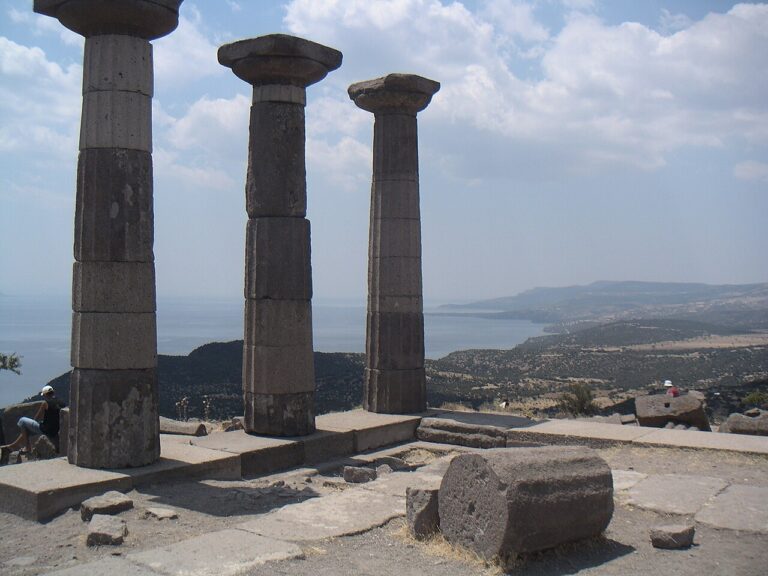
Cleanthes came from Assos, the son of Phanias. Assos was a Greek city on the Aegean coast of what is now Çanakkale province in northwest Turkey, in the region the ancients called the Troad. Diogenes Laertius, a Greek biographer of the third century CE and our main source for his life, says he was a boxer before he turned to philosophy. According to some, he arrived in Athens with only four drachmas, and he became a student of Zeno, staying with him for nineteen years.
To support himself, he took manual work. The best-known story says he drew water in gardens at night so that he could study during the day, which earned him the nickname “Well-lifter.” When he was brought before a court to explain how he made his living, he called as witnesses the gardener whose water he drew and the woman who sold the meal he ground. The judges of the Areopagus, an ancient Athenian council that also sat as a court, were so impressed, according to the story, that they voted him a gift of ten minas, which Zeno would not let him accept. He was called “a second Heracles,” after the strongman hero of Greek myth, and he did not mind being called “the Ass.” He is said to have replied that he alone was strong enough to carry Zeno’s load. He was so poor that he wrote down Zeno’s lectures on oyster shells and the shoulder blades of oxen.
Head of the School
When Zeno died, in about 263 or 262 BCE, Cleanthes became head of the school. Diogenes Laertius notes that Zeno had many other eminent disciples, yet it was Cleanthes who succeeded him. Some of those disciples went their own way. Aristo of Chios, from an island in the eastern Aegean near the coast of Turkey, disagreed with Zeno on key points and lectured in the Cynosarges, one of the gymnasiums of Athens, where he became so influential that he was called the founder of a sect. His followers were known as Aristoneans. Cleanthes, by contrast, held to Zeno’s teaching, and William Smith’s Dictionary of Greek and Roman Biography credits his devotion to Zeno with keeping the system free of outside influences.
He was a prolific writer. Diogenes Laertius lists about fifty titles, on subjects ranging from time and the gods to pleasure, friendship, love, and logic. Only fragments survive, the most important being the hymn.
What Cleanthes Taught
Cleanthes followed Zeno’s framework, but he gave it his own emphasis, especially in physics and theology.
Nature, Fire and the Divine
For the Stoics, the universe is a single living whole, ordered by a rational principle they identified with god. According to Cicero, Cleanthes was not consistent on this point: at times he called the world itself god, at times the mind and soul of the universe, and at times the ether, the fiery upper region that the Stoics identified with the purest form of fire. According to Diogenes Laertius, he also named the sun as the ruling power of the world, where Chrysippus named the heaven. His successor Chrysippus later defined fate as a natural, everlasting ordering of the whole.
Living in Agreement with Nature
Zeno had said that the goal of life is to live in agreement, or, in Diogenes Laertius’s version, to live in agreement with nature. One ancient report credits Cleanthes with adding the words “with nature.” According to Diogenes Laertius, Cleanthes took the nature to be followed to be the nature of the universe alone, the rational order of the whole, and not one’s own individual nature as well, while Chrysippus included both. On Cleanthes’ view, living well means following the rational order of the universe itself.
Virtue Cannot Be Lost
Cleanthes held, against some other Stoics, that virtue once gained cannot be lost, because it rests on a secure grasp of the truth. Chrysippus disagreed and argued that it could be lost through drunkenness or melancholy, a disorder of the mind. The debate shows how seriously the early Stoics took the idea that virtue is a stable condition of the mind, not a mood or a habit that comes and goes.
The Hymn to Zeus
The Hymn to Zeus survives because the anthologist Stobaeus, who probably lived in the fifth century CE, copied it into his collection of excerpts. It praises Zeus not as the quarrelsome god of myth but as the sovereign of nature who rules all things by law. Nothing is done on earth apart from him, the hymn says, except what the wicked do in their folly, and even their deeds are harmonized into one whole, the evil with the good. It ends with a prayer that Zeus scatter the darkness from human souls so that they can find true understanding.
A shorter poem by Cleanthes became even more famous. It stands first among the maxims in the closing chapter of the Enchiridion, or Handbook. The chapter opens by saying that in every circumstance we should hold these maxims “ready to hand”:
Lead me, O Zeus, and thou O Destiny,
Cleanthes, quoted in Epictetus, Enchiridion 53, trans. George Long
The way that I am bid by you to go:
To follow I am ready. If I choose not,
I make myself a wretch, and still must follow.
Seneca, a Roman Stoic of the first century CE, rendered the same prayer in Latin verse in one of his letters. His version closes with a line that has no counterpart in the four lines Epictetus quotes, which in English runs:
Aye, the willing soul Fate leads, but the unwilling drags along.
Seneca, Moral Letters to Lucilius 107.11, trans. Richard M. Gummere
These verses state the Stoic attitude toward fate in a few lines. Events follow a course we do not control. What we do control is whether we go along willingly or fight what cannot be changed and make ourselves miserable in the process.
Death
Ancient accounts say that Cleanthes died by refusing food. According to Diogenes Laertius, his doctors told him to fast for two days to treat a badly inflamed gum. When the treatment worked and they wanted him to eat again, he said he had already got too far on the road and continued fasting until he died. The sources disagree about his age. Diogenes Laertius says only that, according to some, he died at the same age as Zeno. The ancient essay Octogenarians, attributed to Lucian, says he was ninety-nine, while Smith’s Dictionary gives eighty.
Legacy
Cleanthes’ greatest practical contribution may have been the student who followed him. Chrysippus succeeded him as head of the school and became, by all accounts, its foremost theorist and systematizer, so that he is often called the second founder of Stoicism. Cleanthes also taught Sphaerus of Bosporus, and the Macedonian king Antigonus II Gonatas made him a gift of three thousand drachmas. Cleanthes’ own reputation rests on his character and his poetry. Epictetus and Seneca both passed on his prayer to Zeus and Destiny as a model of the Stoic who accepts what fate brings.
Where to Start Reading
Start with the four lines in the closing chapter of the Enchiridion and with Seneca’s Letter 107, which places them in the context of everyday misfortunes. English translations of the Hymn to Zeus, which Stobaeus preserved, are easy to find. For his life, read the chapter on Cleanthes in Book 7 of Diogenes Laertius.
Sources
The quotations on this page come from public-domain translations.
- Epictetus, Enchiridion 53, trans. George Long (Standard Ebooks)
- Seneca, Moral Letters to Lucilius 107.10 to 107.11, trans. Richard M. Gummere (Standard Ebooks)
- Diogenes Laertius, Lives of the Eminent Philosophers 7.37, 7.87, 7.89, 7.127, 7.137, 7.139, 7.168 to 7.176, 7.177, trans. R. D. Hicks (1925, LacusCurtius and Perseus)
- Pseudo-Lucian, Octogenarians (Macrobii) 19 (Perseus)
- Stobaeus, Anthology 1.1.12 (Hymn to Zeus)
- Cicero, On the Nature of the Gods 1.37
- Stanford Encyclopedia of Philosophy, “Stoicism” (Dirk Baltzly) and “Epictetus” (Margaret Graver)
- Encyclopaedia Britannica, “Cleanthes” and “Diogenes Laertius”
- William Smith, Dictionary of Greek and Roman Biography and Mythology, “Cleanthes”
- Encyclopaedia Britannica (1911), “Cleanthes” and “Stobaeus, Joannes” (Wikisource)
- UNESCO World Heritage Centre, tentative list entry “Assos” (location in Çanakkale province)
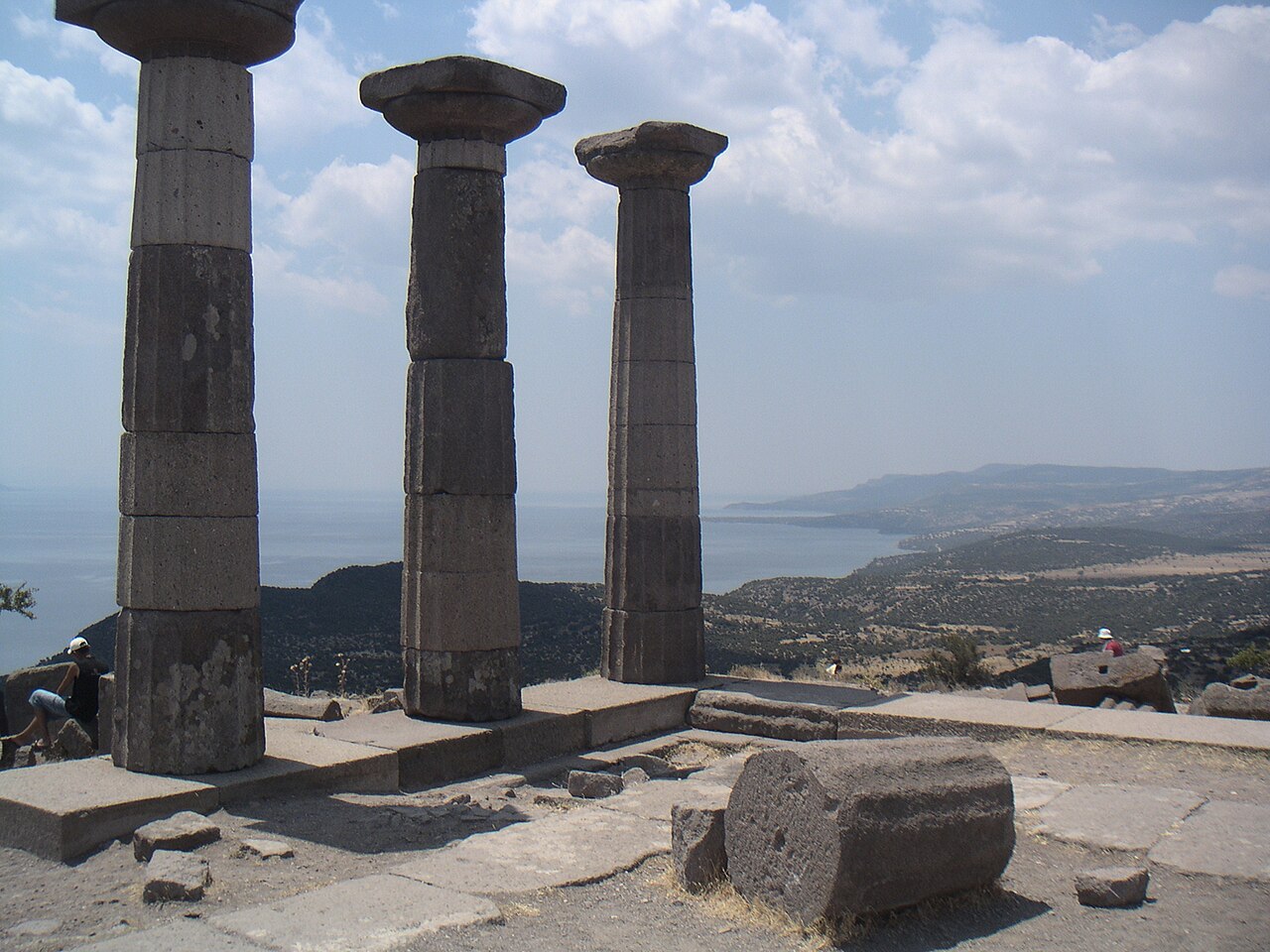
- Title image: the temple of Athena at Assos. Photo by Erik Hermans (Institute for the Study of the Ancient World), CC BY 2.0, via Wikimedia Commons