In Brief
Chrysippus of Soli (c. 280 to c. 206 BCE) was the third head of the Stoic school and the philosopher who gave Stoicism its systematic form. He succeeded Cleanthes around 230 BCE and is said to have written more than 700 works. He is regarded as the school’s foremost theorist, and his work on logic, the passions, and fate was so central that he is often called the second founder of Stoicism.
At a Glance
- Lived
- c. 280 to c. 206 BCE
- Born
- Soli, in Cilicia (southern Asia Minor)
- Head of the school
- c. 230 to c. 206 BCE
- Role
- Third head of the Stoa
- Teacher
- Cleanthes
- Successor
- Zeno of Tarsus
- Surviving work
- Fragments only
Chrysippus is the most important Stoic most people have never read. Not one of his books survives complete. Yet later writers, friendly and hostile, quoted him so often that hundreds of fragments of his work survive. A line recorded by Diogenes Laertius, a Greek biographer of the third century CE, held that without Chrysippus there would have been no Stoa at all.
Life
Chrysippus was the son of Apollonius and was born, most sources say, in Soli, a city in Cilicia near what is now Mersin in southern Turkey, though Diogenes Laertius notes that some said he came from Tarsus. Diogenes Laertius says he trained as a long-distance runner before he took up philosophy. He moved to Athens and studied with Cleanthes, but he was not a passive pupil. According to Sotion, a writer quoted by Diogenes Laertius, he also studied in Plato’s Academy under Arcesilaus and his successor Lacydes. Arcesilaus had begun the Academy’s sceptical phase, and the Stanford Encyclopedia of Philosophy notes that Chrysippus’ reformulation of Stoicism was prompted by Arcesilaus’ criticisms.
The relationship with Cleanthes was respectful but independent. One story has Chrysippus telling his teacher that all he wanted was to be told the doctrines, since he would find the proofs himself. Yet whenever he argued against Cleanthes, he felt remorse, and he often quoted a line of verse: “Blest in all else am I, save only where I touch Cleanthes: there I am ill-fortuned.”
Around 230 BCE, he became head of the school. According to Demetrius, quoted by Diogenes Laertius, he was the first who ventured to hold a lecture class in the open air in the Lyceum, one of the gymnasiums of Athens. He wrote constantly. Diogenes Laertius reports, on the authority of Diocles, that he wrote 500 lines a day, and Diogenes Laertius himself puts the number of his works at more than 705. Critics complained that he repeated himself and filled his books with quotations, and one story says he copied out nearly the whole of Euripides’ play Medea in one of his books, but no one doubted his range.
What Chrysippus Taught
Chrysippus worked on every part of Stoic philosophy. Three areas show his influence most clearly.
Stoic Logic
Aristotle’s logic dealt with terms like “all humans” or “some animals.” Chrysippus developed a different kind of logic built on whole statements and the connections between them: if this, then that; either this or that; not both this and that. The Stoics set out five basic forms of valid argument, which they called indemonstrables, and they were confident that all other valid arguments could be reduced to them. Modern scholars describe this as propositional logic, the branch of logic that studies how statements connect, and Chrysippus was among the first to organize it as a discipline. His logical work was long neglected, and its importance was recognized only in the twentieth century.
For the Stoics, logic was not a separate hobby. They compared philosophy to a fertile field and logic to the fence that protects it, and Diogenes Laertius lists around 311 logical writings among Chrysippus’ works.
The Passions as Judgments
Chrysippus argued, in his treatise On the Passions, that emotions like grief, fear, craving, and pleasure, the four main classes the Stoics recognized, are not forces that overpower reason from outside. They are judgments, and mistaken ones. Avarice, for example, is the supposition that money is a good, and distress rests on the judgment that something bad is present. Since the Stoics held that only vice is truly bad, such judgments are false.
This theory explains why later Stoic therapy focuses so much on examining our beliefs. If an emotion rests on a judgment, then changing the judgment changes the emotion. Seneca, a Roman Stoic of the first century CE, applied the Stoic view that emotions are opinions in his detailed analysis of anger, On Anger.
Fate and Responsibility
The Stoics believed that everything happens according to fate, a chain of causes running through the whole universe. Critics asked how anyone could be responsible for their actions in such a world. Chrysippus answered with an analogy that the Roman statesman and writer Cicero preserves in his treatise On Fate. A cylinder cannot begin to move unless it is pushed, but the person who pushes it gives it only a beginning of motion, not its capacity to roll, which comes from its own nature. In the same way, an impression strikes the mind from outside, but our assent to it remains in our power. Fate supplies the occasion, and we supply the response.
Epictetus, a Stoic teacher of the first and second centuries CE, quotes a related saying of Chrysippus about how a wise person should treat what lies ahead:
So long as future things are uncertain, I always cling to those which are more adapted to the conservation of that which is according to nature; for God himself has given me the faculty of such choice. But if I knew that it was fated (in the order of things) for me to be sick, I would even move towards it; for the foot also, if it had intelligence, would move to go into the mud.
Chrysippus, quoted in Epictetus, Discourses 2.6.9 to 10, trans. George Long
The image of the foot is typical of the Stoics. A foot that could think would accept getting muddy as part of serving the whole body. In the same way, a person who understood their place in the universe would accept what fate brings, while still preferring health and other natural advantages whenever the outcome is open.
Death
Diogenes Laertius says Chrysippus died at the age of seventy-three, in the 143rd Olympiad, the four-year period from 208 to 204 BCE, and records two accounts of his death. In one, taken from Hermippus, he drank undiluted sweet wine at a sacrificial feast, became dizzy, and died five days later. In the other, more famous version, he saw a donkey eating his figs, told an old woman to give it a drink of pure wine to wash them down, and laughed so hard that he died. Another ancient source gave him a longer life: the essay Octogenarians, attributed to Lucian, lists him at eighty-one. Whatever the truth of the donkey story, it shows that the ancient world remembered him as more than a dry logician.
Why His Books Were Lost
None of the first three heads of the Stoa, Zeno, Cleanthes, and Chrysippus, left a single complete work that survives, and Chrysippus’ hundreds of books are known only from about 475 fragments, many of them preserved by opponents. The doctor and philosopher Galen, who settled in Rome in the second century CE, quoted On the Passions at length in his polemic On the Doctrines of Hippocrates and Plato, where he attacked Chrysippus’ views. Plutarch, a Greek biographer and essayist, wrote tracts such as On Stoic Self-Contradictions. Modern scholars have gathered these fragments into the standard collection of early Stoic texts, Hans von Arnim’s Stoicorum Veterum Fragmenta, published from 1903 to 1905.
Legacy
Almost every Stoic doctrine a modern reader meets has passed through Chrysippus. The theory that emotions are judgments, the idea that our assent is up to us even when impressions are not, and the confidence that a rational order runs through events all took their classic form in his work. Epictetus cites him as an authority, and the image of the willing foot in the mud reached later readers through him.
Where to Start Reading
Since his books are lost, start with the authors who preserve his ideas. Cicero’s On Fate explains the cylinder analogy, and Book 4 of Cicero’s Tusculan Disputations, a set of philosophical dialogues, sets out the Stoic theory of the passions as diseases of the soul that arise from false beliefs. The chapter on Chrysippus in Book 7 of Diogenes Laertius gives his life and the list of his works. Epictetus’s Discourses, his lectures as written up by his student Arrian, quote him and show how his ideas were taught some three centuries later.
Sources
The quotations on this page come from public-domain translations.
- Epictetus, Discourses 2.6.9 to 2.6.10, trans. George Long (Project Gutenberg)
- Diogenes Laertius, Lives of the Eminent Philosophers 7.35, 7.40, 7.110 to 7.111, 7.179 to 7.185, 7.189 to 7.202, trans. R. D. Hicks (1925, LacusCurtius and Perseus)
- Cicero, On Fate 42 to 43, trans. H. Rackham
- Cicero, Tusculan Disputations, Book 4
- Pseudo-Lucian, Octogenarians (Macrobii) 20 (Perseus)
- Stanford Encyclopedia of Philosophy, “Stoicism” (Dirk Baltzly), “Arcesilaus”, “Seneca”, “Epictetus” (Margaret Graver), and “Galen”
- Internet Encyclopedia of Philosophy, “Chrysippus” (Jeremy Kirby)
- Encyclopaedia Britannica, “Chrysippus”, “Cicero”, “Plutarch”, and “Diogenes Laertius”
- William Smith, Dictionary of Greek and Roman Biography and Mythology, “Chrysippus” and “Zenon” (Zeno of Tarsus)
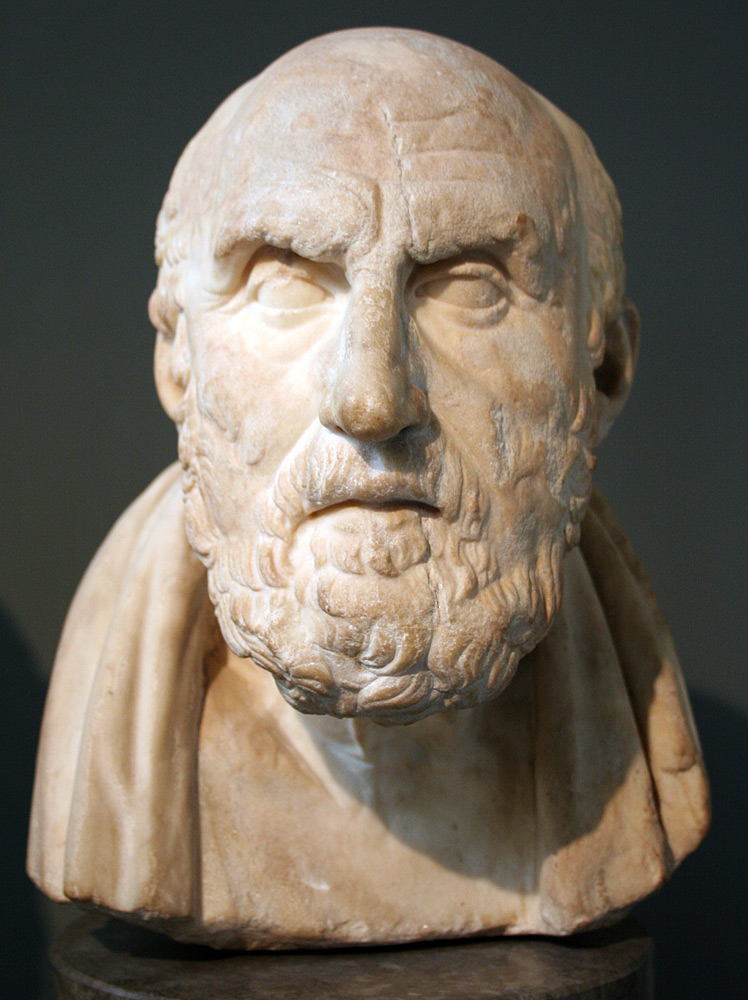
- Portrait: Roman marble head of the portrait type attributed to Chrysippus. Photo public domain, via Wikimedia Commons
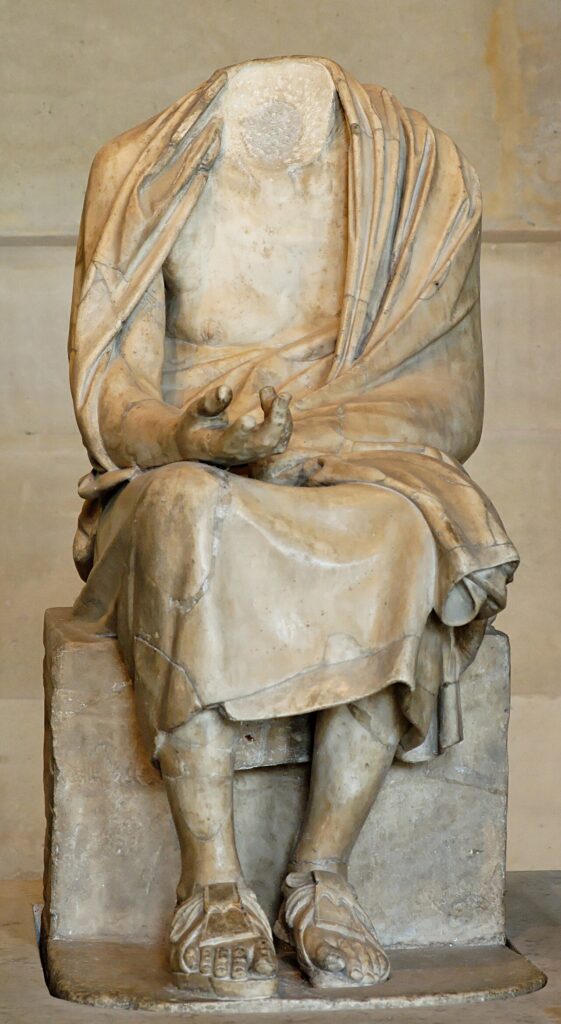
- Image: seated philosopher, possibly Chrysippus, Louvre, Paris (Ma 80). Public domain, via Wikimedia Commons