

In Brief
Gaius Musonius Rufus (c. 30 to c. 100 CE) was one of the great Stoic philosophers of the Roman Empire and the teacher of the Stoic philosopher Epictetus. A Roman knight of Etruscan origin, he was exiled by the emperor Nero and again by the emperor Vespasian. His teaching survives mainly in short lectures, usually thought to have been recorded by a student, which are practical and direct, and which include arguments that women should study philosophy and that daughters should be educated as sons are.
At a Glance
- Lived
- c. 30 to c. 100 CE (dead by 101 or 102)
- Born
- Volsinii, Etruria (modern Bolsena, Italy)
- Status
- Roman knight (equestrian)
- Period
- Roman Stoa
- Exiled
- To Gyaros under Nero (65 CE), and exiled again under Vespasian
- Students
- Epictetus, Dio Chrysostom
- Surviving work
- Twenty-one lectures and short sayings, preserved by later writers
Musonius has been called the Roman Socrates, most famously in the title of Cora Lutz’s 1947 edition and translation of his teachings. Like Socrates, he is not known to have written anything for publication, and scholars still debate whether he wrote at all. Most readers meet him only as a name in the Discourses, the recorded lectures of Epictetus, where he appears as a teacher who spoke so pointedly that each student felt personally accused. His own lectures deserve to be better known.
Life and Exiles
Musonius was born in Volsinii, an Etruscan town on the site of modern Bolsena in Italy, some time before 30 CE. According to the Suda, a Greek encyclopedia of the tenth century, his father was named Capito. His family belonged to the equestrian order, the class ranked second only to senators. By Nero’s reign, Musonius was a famous Stoic teacher in Rome, and he was linked to the senators and intellectuals who opposed the emperor. When Nero banished the nobleman Rubellius Plautus around 60 CE, Musonius went with him into exile in Asia Minor.
In 65 CE, after the failed conspiracy of the Roman statesman Gaius Calpurnius Piso against Nero, Musonius was exiled to Gyaros, an arid, desolate island in the Aegean Sea. Tacitus, the Roman historian, says that it was the fame of his name that drove him into exile. According to Philostratus, in his Life of Apollonius of Tyana, the island had been waterless until Musonius discovered a spring there, and Greeks sailed out to visit him. He returned to Rome under Galba, Nero’s successor, in 68 CE.
The civil wars that followed put him in an awkward position. Tacitus describes him, in 69 CE, joining an embassy that the Senate sent to the armies fighting for Vespasian, the general who soon became emperor. Musonius mingled with the soldiers and lectured them on the blessings of peace and the perils of war. Many thought it ridiculous, more thought it tiresome, and some were ready to jostle him and trample on him, until the warnings of quieter soldiers made him stop. Later, when Vespasian expelled the philosophers from Rome, the historian Cassius Dio, a Roman senator who wrote in Greek, reports that Musonius alone was exempted. Vespasian nevertheless exiled him a second time, and he returned only during the reign of Titus, Vespasian’s son and successor. He was dead by 101 or 102 CE.
The Lectures
Musonius’s teaching survives in twenty-one longer discourses, usually interpreted as the lecture notes of his student Lucius, together with thirty-two short sayings preserved by later writers. The discourses come down to us through Stobaeus, a fifth-century anthologist who collected extracts from earlier Greek writers. Each takes up a practical question: whether a king should study philosophy, whether exile is an evil, what we should eat, and whether we must obey our parents in everything.
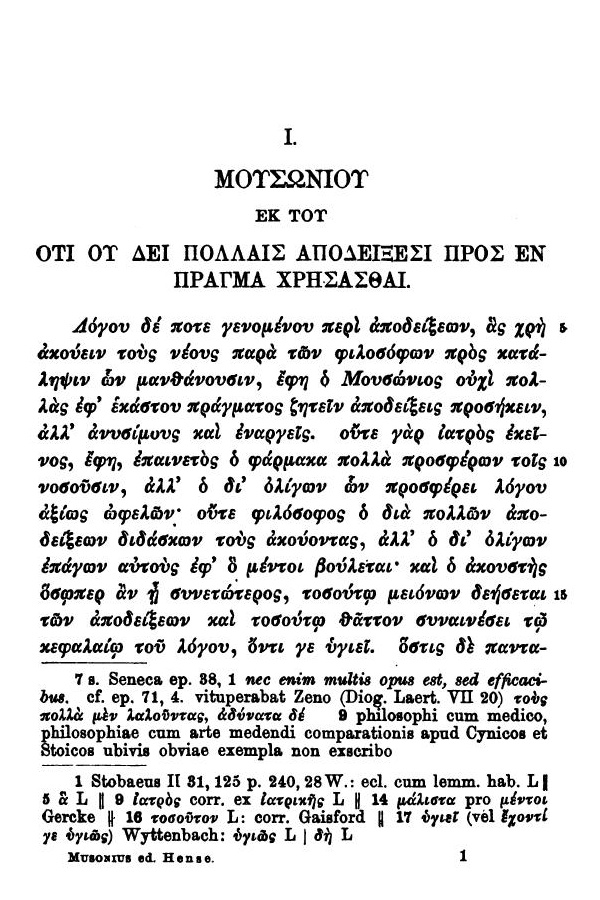
Their tone is practical. Musonius cared less about technical theory than about training, and he held that practice is more important than theory. A good life, for him, depended on daily habits of eating, dressing, and living simply, as much as on argument.
What Musonius Taught
The lectures cover a wide range of everyday questions, but five themes come up again and again. Together, they show how practical his Stoicism was.
Women Should Study Philosophy
Two lectures argue that women should study philosophy and that daughters should receive the same schooling as sons. Musonius’s reasoning is Stoic: the virtues are the same for women and for men, so women need the same training in philosophy. In the lecture on daughters, he describes philosophy as training in nobility of character, and on that view it belongs to everyone. He did not argue for equality in every respect, however, and he was less egalitarian about how certain kinds of work should be divided between the sexes.
Food and the Simple Life
Musonius called the pleasure of eating the most difficult pleasure to combat. He held that a meat-based diet is too crude for human beings and better suited to wild beasts, and he recommended a lacto-vegetarian diet of inexpensive, readily available foods, such as fruit in season, certain vegetables, milk, cheese, and honeycombs. His lectures also cover clothing, housing, and furniture, and they always recommend what is modest and practical over what is expensive and showy.
Marriage and Family
He saw marriage as the foundation of the family and of the city. A marriage, for Musonius, should be a companionship of mutual care, in which husband and wife consider all things common and nothing private, and each tries to outdo the other in care. He also condemned adultery and held men to the same sexual standard as women: a man who slept with his own female slave was, in his view, as blameworthy as a woman who slept with her male slave.
Exile Is Not an Evil
Drawing on his own experience, Musonius argued in his ninth lecture that exile is no more an evil than poverty, injury, or death. Exile does not prevent anyone from possessing courage and justice. A good person, he said, is never harmed or degraded by exile, because his virtues help and sustain him wherever he is.
Philosophy Means Practice
Musonius compared virtue to skills such as medicine, music, and piloting a ship. A person who has only studied the theory of these arts cannot practise them without error, and in the same way, he argued, knowing what virtue is does little good unless a person trains to act on it. Training must cover both soul and body, though the soul needs the greater attention. The body is hardened by enduring cold, hunger, and hard beds, while the soul gains courage by enduring hardship and self-control by abstaining from pleasures.
Teacher of Epictetus
Musonius’s greatest student was Epictetus, who attended his lectures in Rome while still enslaved. Epictetus mentions him several times in the Discourses. He recalls that Rufus used to test him by warning him of what his master might do to him, and he quotes Rufus in the very first chapter of Book 1. One passage describes how Musonius refused to accept empty praise from his students:
Rufus was used to say: “If you have leisure to praise me, I am speaking to no purpose.”
Epictetus, Discourses 3.23.29, trans. George Long
Epictetus goes on to explain that Musonius spoke in such a way that every student sitting there supposed someone had accused him before Rufus, so clearly did he place each man’s faults before his eyes. Epictetus’s own philosophy was deeply influenced by his teacher.
Legacy
Musonius’s influence reached beyond Epictetus. The later Stoic Hierocles and the Christian apologist Clement of Alexandria were both strongly influenced by him. Through Epictetus, Musonius is also linked to Marcus Aurelius, the Stoic emperor, who was introduced to Epictetus’s work by his teacher Junius Rusticus, a Stoic philosopher and Roman statesman. Interest in Musonius continues today: Cora Lutz’s translation of his teachings was reissued by Yale University Press in 2020.
Where to Start Reading
The lectures are short enough to read in an afternoon. Start with the lectures on whether women should study philosophy, on training, and on food. Then read the passages in Epictetus’s Discourses where Rufus appears, especially Book 1, Chapters 1 and 9, and Book 3, Chapter 23, to see how his student remembered him.
Sources
The quotations on this page come from public-domain translations.
- Epictetus, Discourses 1.1, 1.9, and 3.23, trans. George Long
- Musonius Rufus, Lectures 3, 4, 5, 6, 8, 9, 12, 13A, 14, 16, 18A, 19, and 20
- Tacitus, Annals 15.71 and Histories 3.80 to 3.81
- Cassius Dio, Roman History 65.13
- Philostratus, Life of Apollonius of Tyana 7.16
- Suda, entry “Mu 1305” (Musonius)
- Internet Encyclopedia of Philosophy, “Musonius Rufus”
- Bryn Mawr Classical Review 2011.11.47 (review of a translation of Musonius’s lectures)
- World History Encyclopedia, “Musonius Rufus” (quotations from the lecture on exile)
- Cora E. Lutz, “The Roman Socrates,” Yale Classical Studies 10 (1947), and the Yale University Press reissue of her translation (2020), with its contents list (PhilArchive record and library catalogue)
- Image: Musonius Rufus, Reliquiae, ed. Otto Hense (Leipzig, 1905), page 1. Public domain, via Wikimedia Commons
- Title image: aerial view of Gyaros. Photo by Olaf Tausch, CC BY 3.0, via Wikimedia Commons