In Brief
Epictetus (born in the 50s CE, died c. 135 CE) was a Greek Stoic philosopher who was born into slavery and became one of the most influential Stoic teachers of the Roman Empire. He studied in Rome with Musonius Rufus, a leading Stoic teacher, was later banished with other philosophers under the emperor Domitian, and opened a school at Nicopolis in northwestern Greece. He wrote nothing himself. His teaching survives in the Discourses and the Enchiridion, a short handbook, both recorded by his student Arrian, later a historian.
At a Glance
- Lived
- Born in the 50s CE, died c. 135 CE
- Born
- Hierapolis, Phrygia (in modern Turkey)
- Taught in
- Rome, then Nicopolis in Epirus (Greece)
- Period
- Roman Stoa
- Teacher
- Musonius Rufus
- Student
- Arrian of Nicomedia
- Surviving work
- Discourses (4 books) and Enchiridion, recorded by Arrian
Epictetus is best known for the idea that opens the Enchiridion: that some things are up to us and others are not, and that trouble begins when we confuse the two. He taught it as someone who had once been enslaved, with almost nothing in his life up to him, and his words carry the weight of that experience.
Born into Slavery
Epictetus was born sometime in the 50s CE in Hierapolis, a Greek city in Phrygia, near what is now Pamukkale in Turkey. His birth name is unknown. The name Epictetus comes from a Greek word meaning “acquired,” which suggests the status he was born into. He spent his youth in Rome as the slave of Epaphroditus, a wealthy freedman (a former slave) who was an important administrator at the court of the emperor Nero.
Epictetus was lame, and the ancient sources disagree about why. The most famous story comes from Celsus, a pagan critic of Christianity, whose words survive because the Christian scholar Origen quoted them in order to answer them. According to Celsus, when his master was twisting his leg, Epictetus said, smiling and unmoved, that he would break it, and when it broke, he simply asked whether he had not said so. The Suda, a Greek encyclopedia of the tenth century, says instead that he was lame from rheumatism, and Simplicius, a sixth-century commentator on the Enchiridion, says that he was weak in body and lame from an early age. In the Discourses, Epictetus calls himself “a lame old man.”
While still enslaved, Epictetus attended the lectures of Musonius Rufus, the Stoic teacher. In the Discourses, he recalls Rufus testing him by warning him of what his master might do to him. He was later freed, though the sources do not say when, and began teaching philosophy himself in Rome.
Exile and the School at Nicopolis
Under the emperor Domitian, who ruled from 81 to 96 CE, a decree of the Senate drove the philosophers from Rome and from Italy. The date is uncertain: modern accounts date the expulsion that affected Epictetus to 89 CE or to 93 CE. According to Aulus Gellius, a Roman writer of the second century, it was because of that decree that Epictetus withdrew from Rome to Nicopolis, a city in Epirus, on the northwest coast of Greece. Octavian, the future emperor Augustus, had founded the city to celebrate his victory at the battle of Actium in 31 BCE. There, Epictetus opened a school, and his best-known student was Arrian. The Historia Augusta, a late Roman collection of imperial biographies, says that the emperor Hadrian, who ruled from 117 to 138 CE, treated Epictetus with the greatest friendship.
He lived simply, with few possessions. In one discourse, he describes how a thief carried off the iron lamp that stood beside his household gods, and how he told himself that tomorrow he would find an earthen lamp instead. According to Lucian, a Greek satirist of the second century, an admirer later paid a large sum for Epictetus’s earthenware lamp. Epictetus never married, but late in life, according to Simplicius, he adopted a child whom one of his friends was going to abandon because of poverty, and he brought the child up himself. He died around 135 CE.
How His Teaching Survived
Like Socrates, Epictetus wrote nothing. His teaching survives because of Arrian of Nicomedia, a student who later became a Roman senator, consul, governor of Cappadocia, and historian. Nicomedia was the capital of the Roman province of Bithynia, now İzmit in Turkey. In a prefatory letter, Arrian says that he did not write up the Discourses as a literary work and did not publish them himself. He wrote down what he heard Epictetus say, in the same words as far as possible, to keep as a memorial of his teacher’s thought. The result is written in koine, the common Greek of the period, and not in the polished literary Greek of Arrian’s own histories.
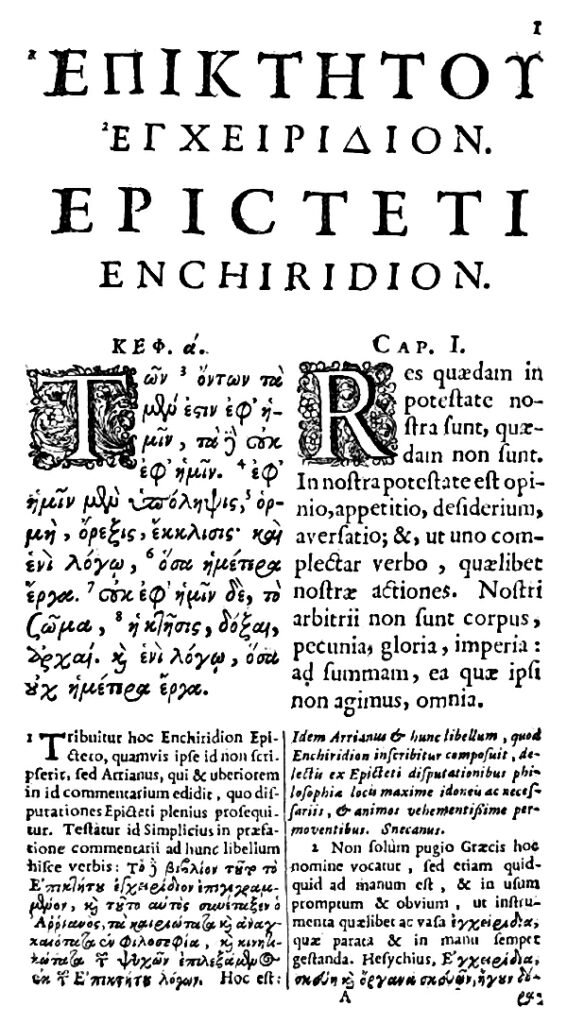
According to Photius, a scholar of the ninth century, the Discourses originally filled eight books, of which four survive. A short abridgment of the main teachings, the Enchiridion, was also compiled by Arrian. The word comes from the Greek for “in the hand,” and as the title of a book it means a handbook. A Latin translation by the Italian humanist Angelo Poliziano was printed in Bologna in 1497, and the Enchiridion went on to enjoy wide success in Renaissance Europe.
What Epictetus Taught
Epictetus taught a small number of ideas and came back to them constantly. Three of them sit at the centre of everything he said to his students.
What Is Up to Us
The Enchiridion opens with its central idea:
Of things some are in our power, and others are not.
Epictetus, Enchiridion 1, trans. George Long
In our power, Epictetus explains, are opinion, movement towards a thing, desire, and aversion: in short, whatever are our own acts. Not in our power are the body, property, reputation, and offices of authority. Trouble begins when we treat what is not up to us as if it were. Modern writers, such as William B. Irvine in A Guide to the Good Life (2009), call this the dichotomy of control.
Impressions and Judgments
Epictetus taught that we are disturbed not by events but by our opinions about them. Things appear to us in certain ways, and before we accept these appearances, we should examine them. The Enchiridion tells the student to say to every harsh appearance, “You are an appearance, and in no manner what you appear to be,” and then to test it by asking whether it concerns something in our power or not. This practice of testing impressions sits at the heart of his method.
The Enchiridion puts the point in a single sentence that has been quoted ever since:
Men are disturbed not by the things which happen, but by the opinions about the things
Epictetus, Enchiridion 5, trans. George Long
His example is death. Death is not terrible in itself, he says, or Socrates would have found it so. What is terrible is the opinion that death is terrible. When we are troubled, Epictetus tells his students, we should blame our own opinions and not other people. An ill-instructed person blames others, a person who has begun to be instructed blames himself, and a person whose instruction is complete blames no one.
The Discipline of Freedom
For Epictetus, freedom means wanting only what is in our power. The Enchiridion says that whoever has power over the things a person wishes for or avoids is that person’s master, so anyone who wishes to be free should neither wish for nor avoid anything that depends on others. A person who wants what others control is, in his words, a slave. The Discourses return again and again to this theme. In the first chapter, he imagines a tyrant threatening a philosopher with chains, prison, and beheading, and he asks what a man should have in readiness in such circumstances:
What is mine, and what is not mine; and what is permitted to me, and what is not permitted to me. I must die. Must I then die lamenting?
Epictetus, Discourses 1.1, trans. George Long
His Portrait
The standard modern reference works on Epictetus describe no ancient portrait of him. The pictures often found online are later imaginings, not likenesses. A fifteenth-century manuscript, for example, shows him in an invented conversation with the emperor Hadrian, and a familiar engraving comes from the frontispiece of Edward Ivie’s Latin version of the Enchiridion, printed in Oxford in the eighteenth century.
Legacy
Epictetus remained famous long after his death. Origen, the Christian scholar, judged that his popularity rivalled Plato’s, and Herodes Atticus, one of the teachers of Marcus Aurelius, called him the greatest of the Stoics, according to Aulus Gellius. Marcus Aurelius, the Roman emperor and Stoic, thanks his teacher Junius Rusticus, a Stoic philosopher and statesman, for sharing the discourses of Epictetus with him from his own collection. Marcus Aurelius never studied with Epictetus, but he was so impressed by his writings that he considered himself a follower. Christian writers produced three adaptations of the Enchiridion, and it was used in monasteries. In the modern era, Albert Ellis, the founder of rational emotive behaviour therapy, one of the cognitive behavioural therapies, named Epictetus and Marcus Aurelius among its philosophical roots and quoted the Enchiridion‘s saying that people are disturbed not by things but by the views they take of them.
Where to Start Reading
Start with the Enchiridion, which takes less than an hour to read. Then read Book 1 of the Discourses, beginning with the first chapter, on what is in our power. George Long’s nineteenth-century translation of both is in the public domain.
Sources
The quotations on this page come from public-domain translations.
- Epictetus, Enchiridion 1, 5, and 14, trans. George Long
- Epictetus, Discourses 1.1, 1.9, 1.16, and 1.18, trans. George Long
- Arrian, letter to Lucius Gellius, prefaced to the Discourses
- Origen, Against Celsus 7.53 (Celsus’s story of the broken leg)
- Aulus Gellius, Attic Nights 1.2.6 (Herodes Atticus’s praise) and 15.11 (the expulsion under Domitian)
- Historia Augusta, Life of Hadrian 16.10
- Lucian, The Ignorant Book-Collector 13
- Suda, entry “Epsilon 2424” (Epictetus)
- Marcus Aurelius, Meditations 1.7
- Stanford Encyclopedia of Philosophy, “Epictetus”
- Internet Encyclopedia of Philosophy, “Epictetus”
- George Long, “Life of Epictetus,” introduction to his translation (reporting Simplicius’s commentary on the Enchiridion)
- Bryn Mawr Classical Review 2009.09.28 (review of William B. Irvine, A Guide to the Good Life)
- EBSCO Research Starters, “Rational Emotive Therapy” (on Albert Ellis and the Stoics)
- Albert Ellis, 1991 Alfred Korzybski Memorial Lecture, General Semantics Bulletin 58 (1993)
- World History Encyclopedia, image notes on the portraits of Epictetus
- Lapham’s Quarterly, page on Epictetus (the meaning of his name)
- World History Encyclopedia, “Arrian”
- Encyclopaedia Britannica, “Nicopolis Actia”
- Bodleian Library, catalogue of incunabula (the 1497 Bologna printing)
- University of Verona, ClaRE/GEMS database (the Enchiridion in Renaissance Europe)
- Boter, study of the three Christian adaptations of the Enchiridion (De Gruyter Brill)
- Merriam-Webster, “enchiridion”
- Image: Epictetus, Enchiridion, ed. Abraham Berkel (1683), chapter 1. Public domain, via Wikimedia Commons
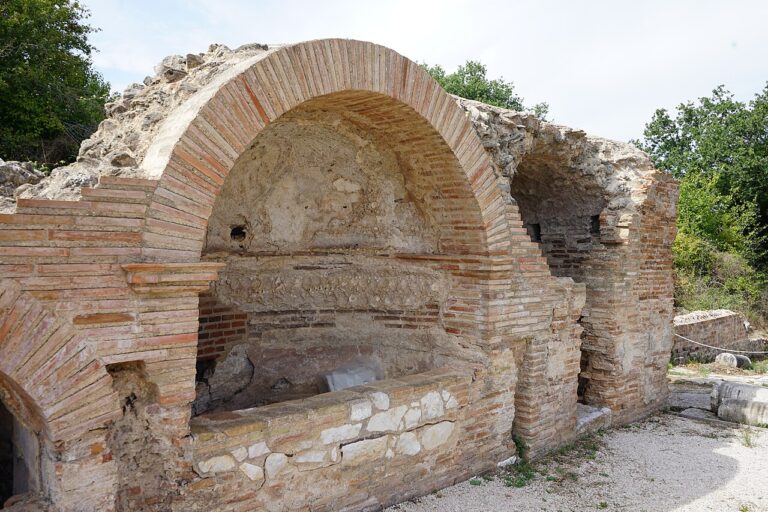
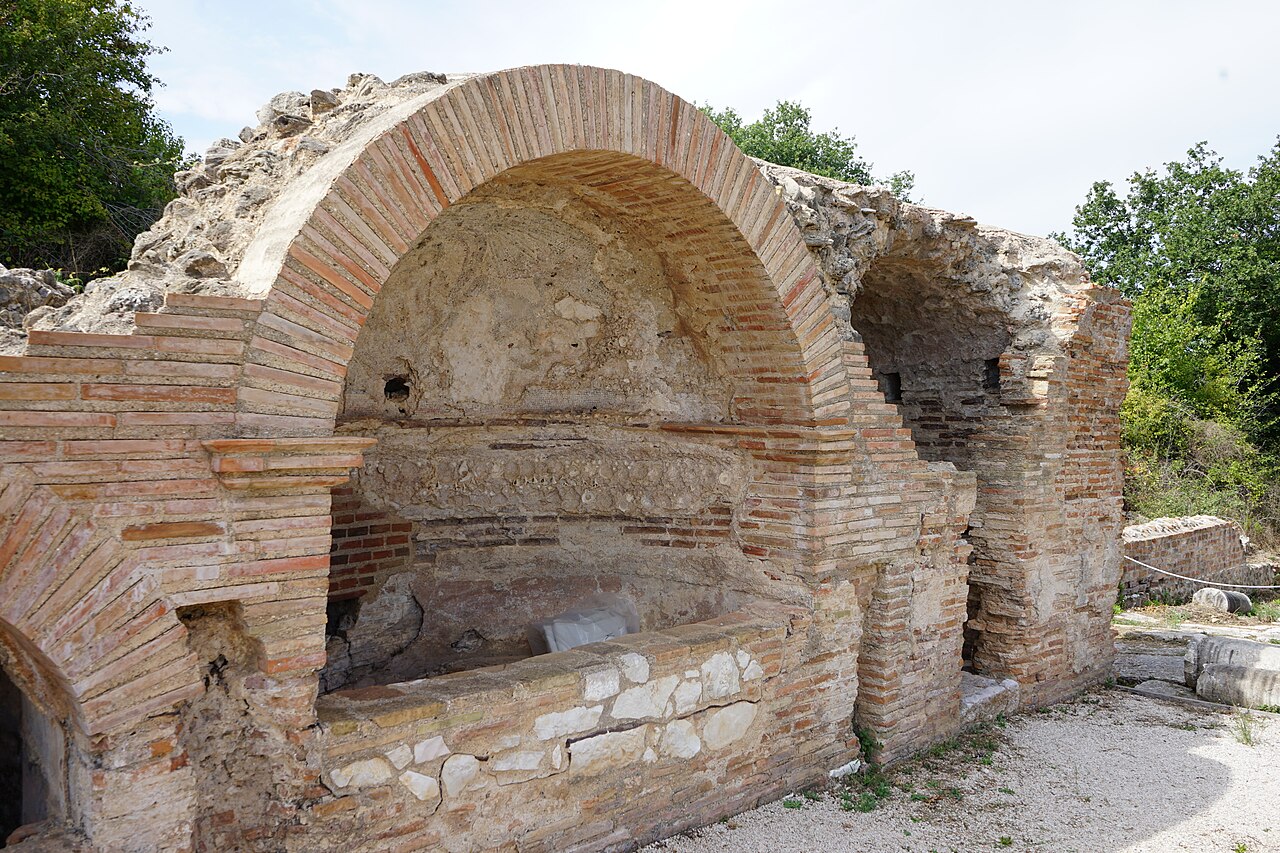
- Title image: small nymphaeum, Nicopolis. Photo by Albinfo, CC0, via Wikimedia Commons