In Brief
Marcus Aurelius (121 to 180 CE) was Roman emperor from 161 until his death in 180 CE and the author of the Meditations, a private notebook of Stoic reflections written in Greek. He ruled through years of war on the Danube frontier and a devastating plague, and he wrote to remind himself how to live and govern well. His reputation as a philosopher rests on this one work.
At a Glance
- Lived
- 26 April 121 to 17 March 180 CE
- Born
- Rome
- Emperor
- 161 to 180 CE (with Lucius Verus until 169)
- Period
- Roman Stoa
- Teachers
- Junius Rusticus, Fronto, Apollonius of Chalcedon
- Influences
- Epictetus
- Surviving work
- Meditations, letters to and from Fronto
Plato imagined a philosopher king, a ruler trained in philosophy, and Marcus Aurelius took the idea to heart. According to the Historia Augusta, a late Roman collection of imperial biographies, he always had on his lips Plato’s saying that states prosper where philosophers are kings or kings are philosophers. The Meditations, however, was written for his own use, not for readers. It is the record of a man trying, day after day, to hold himself to principles he found hard to live by.
Early Life and Education
Marcus Aurelius was born in Rome on 26 April 121 CE, in a villa on the Caelian Hill, according to the Historia Augusta. His father died, probably when the boy was about three years old, and, according to the Historia Augusta, he was brought up by his paternal grandfather. The emperor Hadrian, who ruled from 117 to 138 CE, took an interest in the boy early, and he was brought up under Hadrian’s eye. In 138 CE, as part of his succession plans, Hadrian adopted Antoninus Pius, who became the next emperor. The condition was that Antoninus, in turn, adopt Marcus Aurelius and the young Lucius Verus, the son of Lucius Aelius, Hadrian’s earlier chosen heir. The Historia Augusta gives a different version, in which Marcus Aurelius was to adopt Lucius. It also says that he was in his eighteenth year, though by the birth date it gives, he was sixteen.
He was taught by a series of distinguished teachers. His masters in oratory included Marcus Cornelius Fronto, whom his contemporaries ranked as an orator second only to Cicero, and their surviving letters show a warm relationship. Philosophy drew him early: the Historia Augusta says that at twelve he adopted the dress of a philosopher, and he later gave up rhetoric for philosophy. Book 1 of the Meditations lists what he learned from family and teachers. He credits the Stoic Junius Rusticus, who was twice consul and served as prefect of the city of Rome, with sharing the discourses of Epictetus, the former slave turned Stoic teacher, from his own collection. Marcus Aurelius never studied with Epictetus, but he came to regard himself as a follower.
Emperor
When Antoninus Pius died in 161 CE, Marcus Aurelius became emperor. He made his adoptive brother Lucius Verus co-emperor, and the Historia Augusta notes that this was the first time the Roman Empire had two emperors. Their reign was soon troubled. A war with Parthia, a rival empire centred in Iran, ended in Roman victory in 166 CE. But the returning army brought back a plague, now called the Antonine Plague, which broke out in 165 or 166 and devastated the population of the empire. Modern estimates of its death toll vary widely, from about 2 percent to about 25 percent of the empire’s population.
From 166 or 167 CE onward, Germanic peoples crossed the Danube frontier into the Roman provinces. Lucius Verus died early in 169 CE, and Marcus Aurelius spent much of the rest of his life on campaign in the Marcomannic Wars, named after the Marcomanni, a Germanic people. For about three years in the early 170s CE, he directed the war from Carnuntum, a Roman legionary base on the Danube. In 175 CE, he also faced a rebellion by Avidius Cassius, the Roman commander in the eastern provinces, who declared himself emperor after hearing false reports of Marcus Aurelius’s death. According to Cassius Dio, a Roman senator and historian who wrote in Greek, the revolt collapsed after three months and six days, when a centurion and a junior officer killed Cassius.
He died on 17 March 180 CE, while still on campaign. Ancient sources disagree about where: the historian Aurelius Victor names Vindobona, modern Vienna, while the Christian writer Tertullian names Sirmium, a Roman city on the site of modern Sremska Mitrovica in Serbia. His son Commodus, who ruled alone from 180 to 192 CE, succeeded him. Cassius Dio, who lived through the next reign, wrote that with this change his history descended from a kingdom of gold to one of iron and rust, and some modern scholars treat the death of Marcus Aurelius as the end of the Pax Romana, the long Roman peace.
The Meditations
Marcus Aurelius probably wrote the Meditations in the 170s CE, much of it while on campaign. The Greek title the work has come down with, ta eis heauton, means roughly “To Himself,” which describes it well. It is divided into twelve books of short entries, some a single sentence and some a page or two. Notes at the end of Books 1 and 2 place them “among the Quadi at the Granua” and “in Carnuntum.” The Quadi were a Germanic people whose lands lay north of the Danube frontier, and Carnuntum lay on the Danube, between modern Vienna and Bratislava.
The entries repeat themselves, often deliberately. They are exercises, not essays: reminders to look at things as they are, to remember death, to do his duty without complaint, and to treat others with patience.
What Marcus Aurelius Taught Himself
The Meditations keeps returning to a handful of themes. Four of them show how Marcus Aurelius used Stoic philosophy as a daily practice rather than a theory.
Preparing for the Day
One of the best-known passages opens Book 2:
Begin the morning by saying to thyself, I shall meet with the busybody, the ungrateful, arrogant, deceitful, envious, unsocial.
Marcus Aurelius, Meditations 2.1, trans. George Long
He goes on to remind himself that such people act out of ignorance of good and evil, that the wrongdoer is his kinsman, sharing in the same intelligence, and that none of them can injure him, since no one can fix on him what is ugly. Nor can he be angry with a kinsman or hate him. This is a morning exercise: rehearsing the day ahead so that its difficulties do not take him by surprise.
Impermanence
Marcus Aurelius returns again and again to the brevity of life and the constant change of all things. In one entry, he asks himself to consider the times of the emperor Vespasian, with people marrying, bringing up children, feasting, and fighting, and then the times of Trajan, and to see that all of those lives are gone. He also reminds himself that the present is the only thing of which anyone can be deprived, since no one can lose the past or the future, so the longest life and the shortest lose just the same at death.
The Common Good
For Marcus Aurelius, human beings are made for one another. In the same entry that opens Book 2, he writes that we are made for cooperation, like feet, hands, eyelids, and the rows of upper and lower teeth, and that to act against one another is contrary to nature. As emperor, he warns himself against being changed by his power:
Take care that thou art not made into a Caesar, that thou art not dyed with this dye; for such things happen.
Marcus Aurelius, Meditations 6.30, trans. George Long
The View from Above
He copies out advice that he attributes to Plato: whoever talks about human beings should look at earthly things as if from some higher place, seeing people in their assemblies, armies, farm work, and marriages all at once. The exercise appears in Book 7 of the Meditations.
Portraits
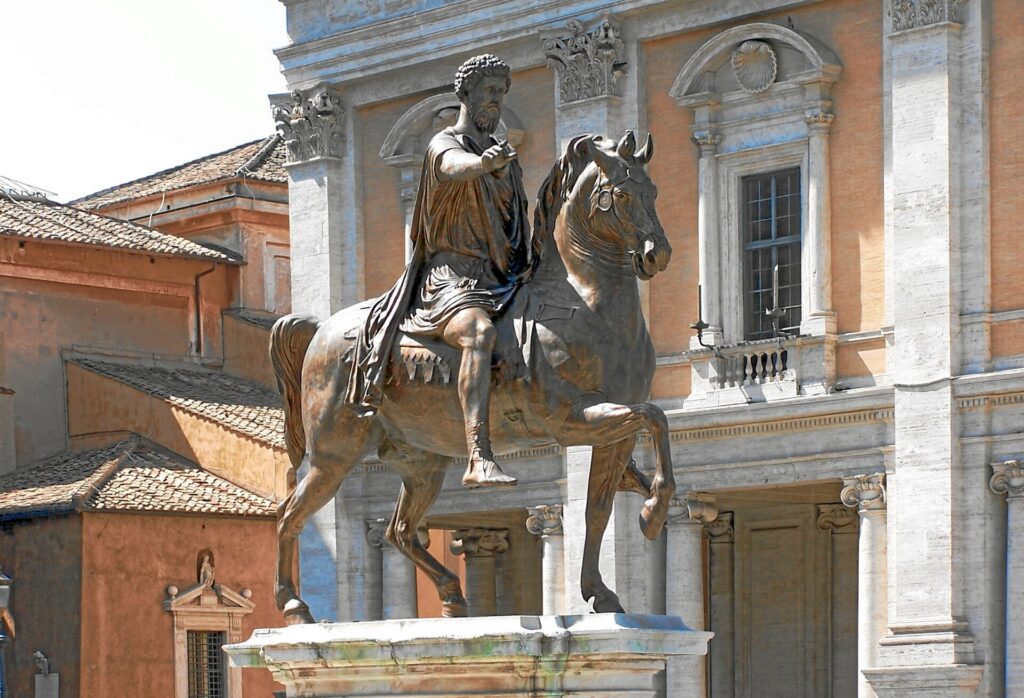
Because Marcus Aurelius was an emperor, his likeness was reproduced on coins and medallions and in marble portraits whose types modern scholars have catalogued in detail. The best known is the bronze equestrian statue now in the Capitoline Museums in Rome, probably made around 176 or 180 CE. The Historia Augusta adds that statues of him still stood among the household gods in many Roman homes long after his death. The equestrian statue escaped being melted down in the Middle Ages because people believed the rider was Constantine, a Christian emperor of the fourth century. In 1538, Pope Paul III had it moved to the Capitoline Hill, where Michelangelo was redesigning the square.
Legacy
The Meditations survived through a small number of manuscripts. The modern text rests mainly on a fourteenth-century manuscript in the Vatican Library and on a manuscript, now lost, that was used for the first printed edition. That edition, with a Latin translation by Wilhelm Xylander, was printed in Zurich in 1558 or 1559 (sources differ on the year). The first English translation, by Meric Casaubon, followed in 1634. Throughout the book, Marcus Aurelius does not present himself as wise. He presents himself as trying.
Where to Start Reading
Read Book 2 of the Meditations first, then Books 4 to 6, which contain many of the core recurring themes. Book 1, his list of thanks to the people who shaped him, makes more sense once you know the rest. George Long’s 1862 translation is in the public domain.
Sources
The quotations on this page come from public-domain translations.
- Marcus Aurelius, Meditations 1.7, 1.8, 1.11, 2.1, 2.14, 4.32, 6.30, and Book 7 (the view from above), and the closing notes of Books 1 and 2, trans. George Long (The Thoughts of the Emperor M. Aurelius Antoninus, 1862)
- Historia Augusta, Life of Marcus Aurelius 1.5, 1.10, 2.4, 2.6, 2.7, 3.3, 4.1, 5.1 (its version of the adoption terms), 5.6, 7.5 to 7.6, 13.3, 18.6, and 27.7
- Cassius Dio, Roman History Book 71 (the Parthian war) and 72.27, 72.33 to 72.34, and 72.36 (Avidius Cassius, the death of Marcus Aurelius, and the verdict on his reign)
- Historia Augusta, Life of Verus 8.1 to 8.2 (the returning army and the plague)
- Tertullian, Apology 25 (Sirmium as the place of death)
- Internet Encyclopedia of Philosophy, “Marcus Aurelius”
- Stanford Encyclopedia of Philosophy, “Epictetus” (Marcus Aurelius as a follower of Epictetus)
- Capitoline Museums, “Equestrian Statue of Marcus Aurelius” and “Marcus Aurelius Exedra”
- Smarthistory, “Equestrian Sculpture of Marcus Aurelius”
- Christian Niederhuber, Roman Imperial Portrait Practice in the Second Century AD: Marcus Aurelius and Faustina the Younger (Oxford), chapters on coins and marble portraits
- Livius.org, “Marcus Aurelius” (dates, the adoption, and Aurelius Victor on Vindobona as the place of death)
- World History Encyclopedia, “Marcus Aurelius” (family, the adoption terms, and the Parthian war)
- Encyclopaedia Britannica, “Marcus Aurelius”
- Carnuntum archaeological park, official site (the Marcomannic Wars and Marcus Aurelius at Carnuntum)
- Anestis Karasaridis, report on the Antonine Plague, Sacra (2020) (modern mortality estimates)
- John Sellars, Royal Holloway, on the first printing of the Meditations (Zurich, 1558 or 1559)
- History Hit, “Carnuntum”
- William Smith, Dictionary of Greek and Roman Biography and Mythology, “Fronto” and “Rusticus”
- The Martyrdom of Justin (Rusticus as prefect of the city)
- Berger et al., open world history textbook (LibreTexts) (the end of the Pax Romana)
- D. A. Rees, Classical Quarterly (2000), as cited by Roger Pearse (the fourteenth-century Vatican manuscript)
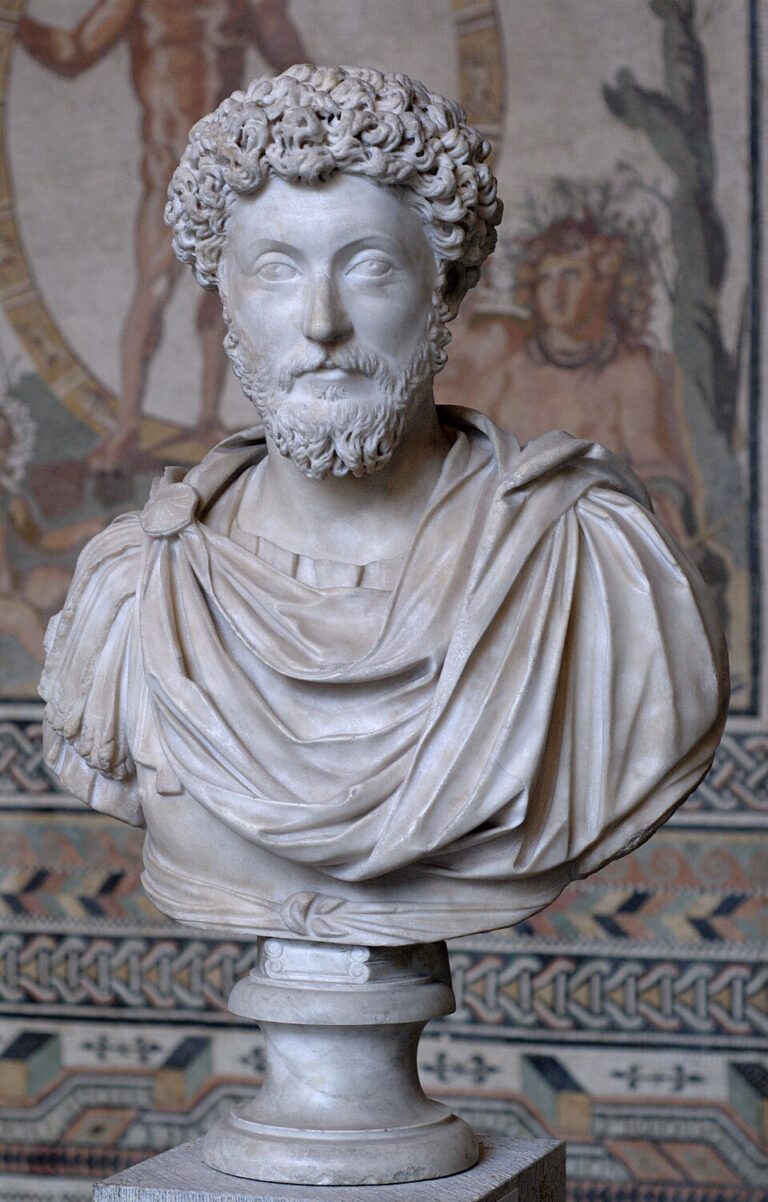
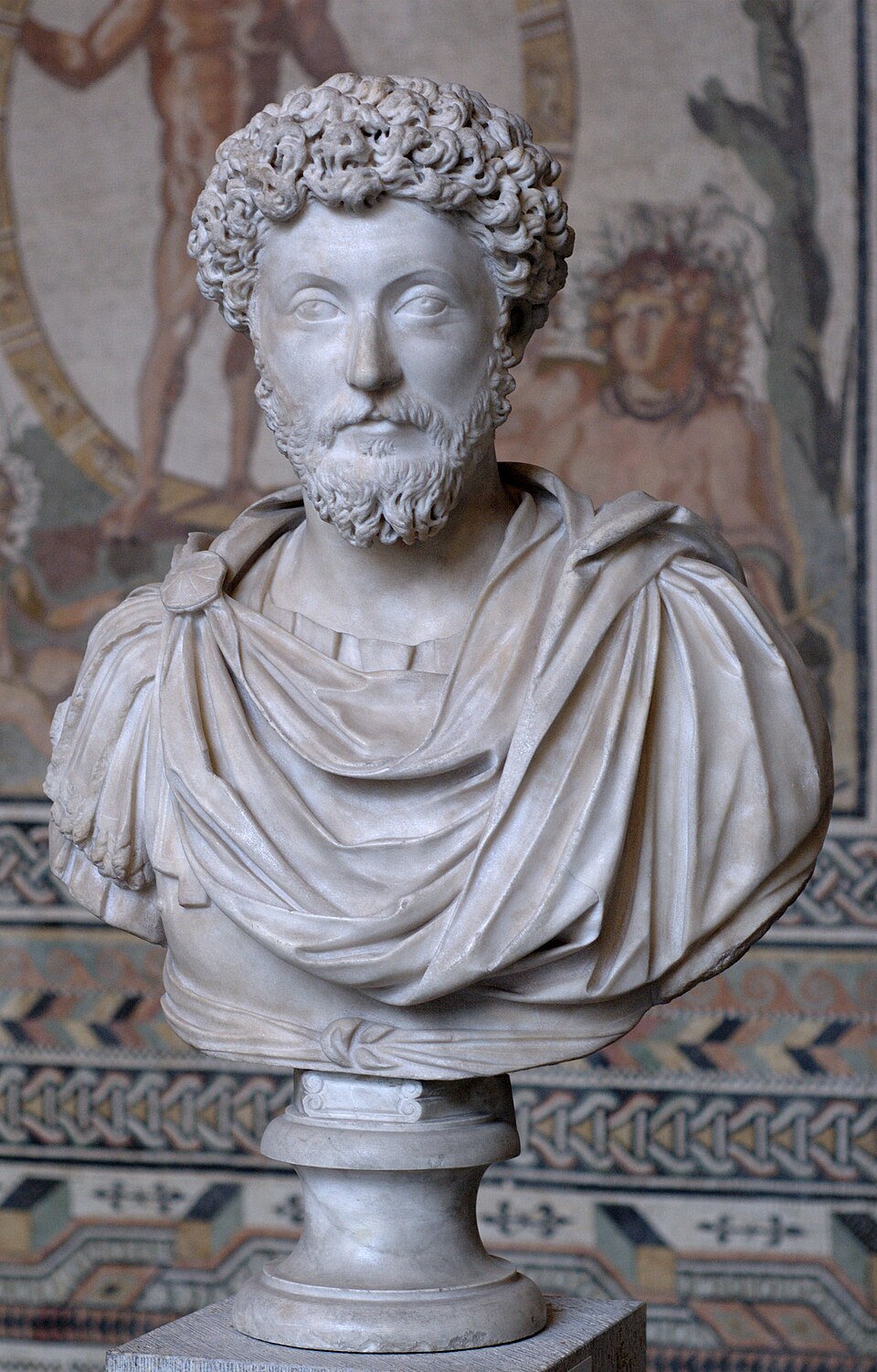
- Portrait: bust of Marcus Aurelius, Glyptothek, Munich. Photo public domain, via Wikimedia Commons
- Image: equestrian statue of Marcus Aurelius, Capitoline Hill, Rome. Photo by Berthold Werner, public domain, via Wikimedia Commons