In Brief
Posidonius of Apamea (c. 135 to 51 BCE) was a Stoic philosopher, scientist, and historian who taught on the island of Rhodes. A student of Panaetius, he was famous for the range of his interests, which took in astronomy, geography, the tides, history, and ethics. The Roman statesman Cicero attended his lectures, and the general Pompey visited him at least twice. His books survive only in fragments, but the geographer Strabo called him the most learned of the philosophers of his time.
At a Glance
- Lived
- c. 135 to 51 BCE
- Born
- Apamea, Syria
- Taught in
- Rhodes
- Period
- Middle Stoa
- Teacher
- Panaetius
- Students and listeners
- Cicero, Pompey (visitor)
- Surviving work
- Fragments only
If Panaetius brought Stoicism into Roman public life, Posidonius made it intellectually fashionable. Roman statesmen travelled to Rhodes to hear him, and later writers on geography and history, including Strabo and Diodorus of Sicily, drew heavily on his work. He also questioned parts of the theory of the passions that Chrysippus, the third head of the Stoic school, had laid down, although scholars disagree about how far he departed from it.
Life
Posidonius was born into a Greek family in Apamea, a Hellenistic city on the Orontes River in what is now northern Syria. As a young man, he went to Athens and studied with Panaetius, then head of the Stoic school. Rather than stay in Athens, he settled on Rhodes, an island near the southwest coast of modern Turkey, where, according to Strabo, he took part in public affairs and taught. Under Posidonius, according to Britannica, the school on Rhodes drew many scholars, and Roman statesmen came to hear him.
He attained high office on Rhodes, and in 87 or 86 BCE, he went to Rome as an ambassador for the island. He travelled widely in the western Mediterranean, visiting Spain, Gaul, Italy, Sicily, and North Africa. At Gades, modern Cádiz, a port on the Atlantic coast of southwest Spain, he studied the tides.
Cicero studied with him on Rhodes in 78 and 77 BCE, according to Britannica, and later called him a friend. Strabo says that Pompey attended one of his lectures on his way to fight the pirates, a visit Smith’s Dictionary dates to 67 BCE, and Plutarch and Cicero describe a second visit on his way home from the East, in 62 BCE. Cicero reports a story that Pompey liked to tell: although Posidonius was in great pain in his joints, he lectured to the general from his sickbed on the theme that nothing is good except what is honourable, and whenever the pain grew worse, he said that it might be troublesome but would never make him admit that it was an evil.
He died around 51 BCE. According to Long Lives, an ancient work attributed to Lucian, he reached the age of eighty-four.
A Philosopher of Everything
Posidonius ranged across nearly every field of ancient learning. The titles and subjects of more than twenty of his works are known, although all of them are lost. His interests ran from the size of the earth and the movements of the sea to the history of Rome and the workings of the human soul.
Science and Geography
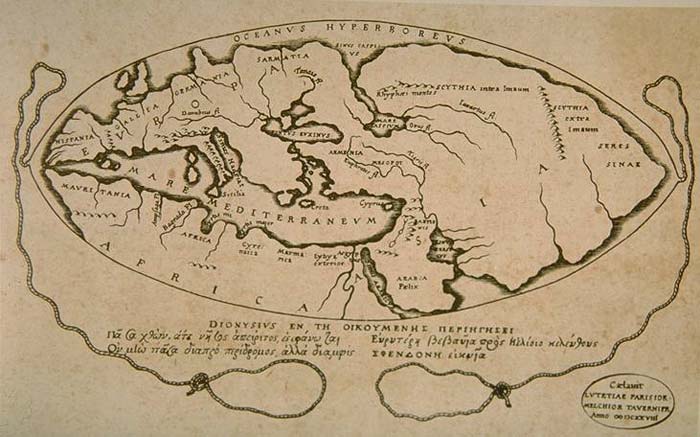
He tried to calculate the circumference of the earth. According to Cleomedes, whose work on astronomy preserves the method, Posidonius noted that the star Canopus barely clears the horizon at Rhodes but stands about one forty-eighth of a circle above it at Alexandria in Egypt. Taking the distance between the two cities as 5,000 stadia, he multiplied by forty-eight and arrived at 240,000 stadia. The MacTutor history of mathematics archive calls this a very accurate value, but one produced by two errors that cancelled each other out. Strabo, however, reports a much smaller figure of about 180,000 stadia, and some scholars doubt that this lower value was really his. Ptolemy, the second-century CE astronomer and geographer of Alexandria, used the lower figure in his Geography, and some historians have suggested that, through Ptolemy’s work, it helped persuade Columbus that Asia lay within reach by sailing west.
Strabo, who discusses Posidonius’s treatise On the Ocean at length, reports that Posidonius described the tides at Gades as following daily, monthly, and yearly cycles, with the daily and monthly cycles tied to the moon. He also tried to measure the size of the sun, which he believed was larger than the earth.
History
Posidonius wrote a long history continuing the work of Polybius, a Greek historian of Rome’s rise. According to Britannica, it covered the years from 146 to 88 BCE in fifty-two books, although some accounts carry it later. It included detailed descriptions of the peoples he met on his travels, including the Celts of Gaul. Later writers drew on it heavily, including Diodorus of Sicily, a Greek historian of the first century BCE, and the Greek geographer Strabo, and some scholars believe that Julius Caesar used it in his accounts of the Celts.
Cosmic Sympathy
Like other Stoics, Posidonius held that all parts of the world are bound together, a link the Greeks called sympathy, and he believed it meant that signs in nature could support predictions. Cicero reports that he wrote five books on divination and held that there are three ways in which people dream as the result of divine impulse.
The Passions and the Soul
Posidonius’s most important contribution to Stoic ethics was a disagreement, although its extent is debated. Chrysippus had treated emotions, which the Stoics called passions, as a kind of mistaken judgment. Posidonius considered parts of this account inadequate. According to Galen, he asked, for example, why emotions fade over time even when the judgments behind them remain, and he accepted, drawing on Plato, that the soul has a non-rational part as well as reason.
We know about this debate mainly from Galen, a medical writer of the second century CE, who quoted Posidonius at length in order to attack Chrysippus. Galen was a hostile witness, and some modern scholars think he exaggerated the disagreement and that Posidonius may have been refining Chrysippus’s account rather than overturning it. The Stanford Encyclopedia of Philosophy notes that scholars remain divided on the question.
Posidonius in Seneca
Seneca, the Roman Stoic writer, writing about a century later, quotes Posidonius often and counts him among those who had contributed most to philosophy. In a letter about illness, he cites him on the value of a life spent learning:
A single day among the learned lasts longer than the longest life of the ignorant.
Posidonius, quoted in Seneca, Moral Letters to Lucilius 78.28, trans. Richard M. Gummere
In Letter 90, Seneca also discusses Posidonius’s view that in a golden age, wise men governed, and that philosophers invented the arts and crafts, from building houses to weaving. Seneca disagrees, arguing that such inventions came from human ingenuity, not wisdom, and that wisdom trains not the hands but the mind. The exchange shows how freely the Stoics argued with one another, even across centuries.
What Survives
None of Posidonius’s books survives intact. The standard modern edition, by L. Edelstein and I. G. Kidd, gathers a set of testimonia, ancient reports about his life and work, together with 293 numbered fragments from later authors, including Strabo, Seneca, Galen, and Cicero. Because so much of his work reaches us through writers with aims of their own, such as Galen, scholars treat these reports with care.
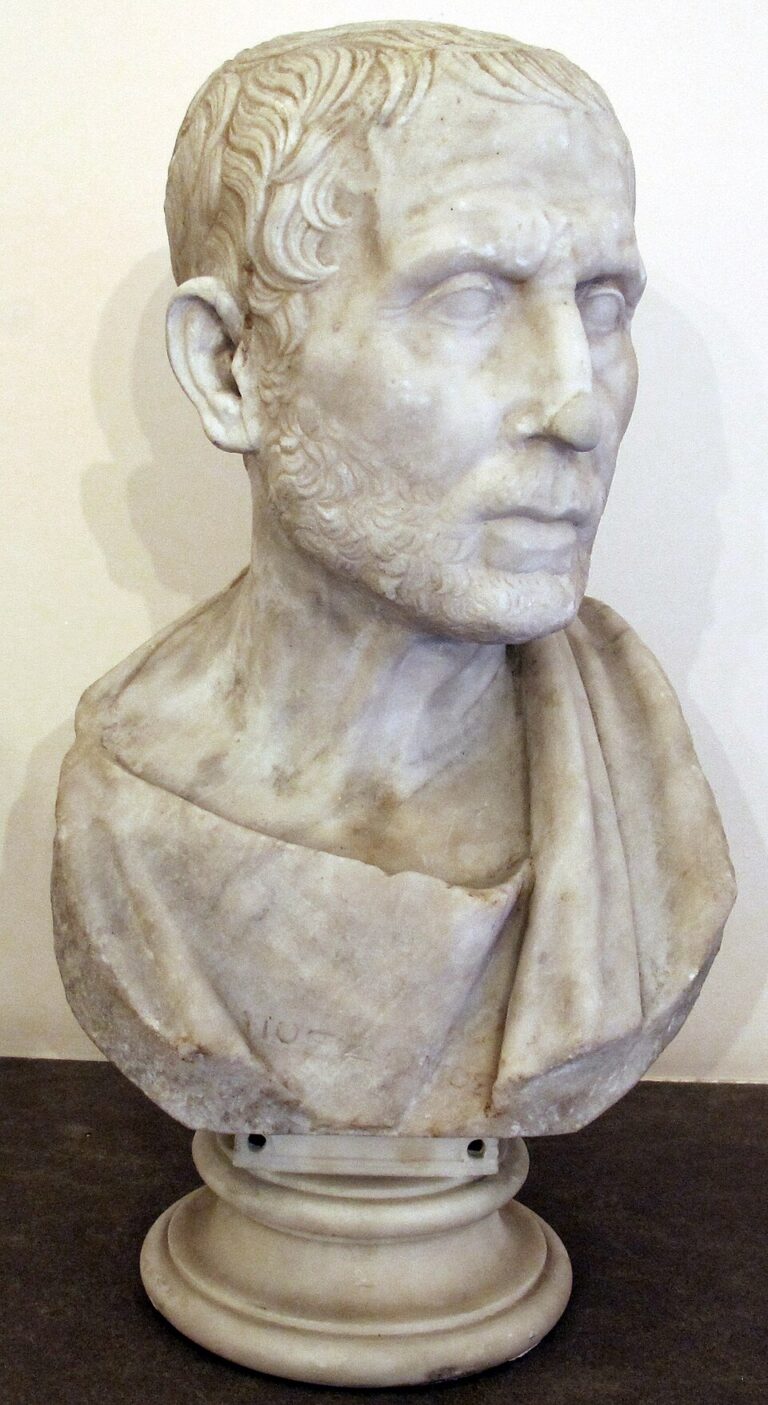
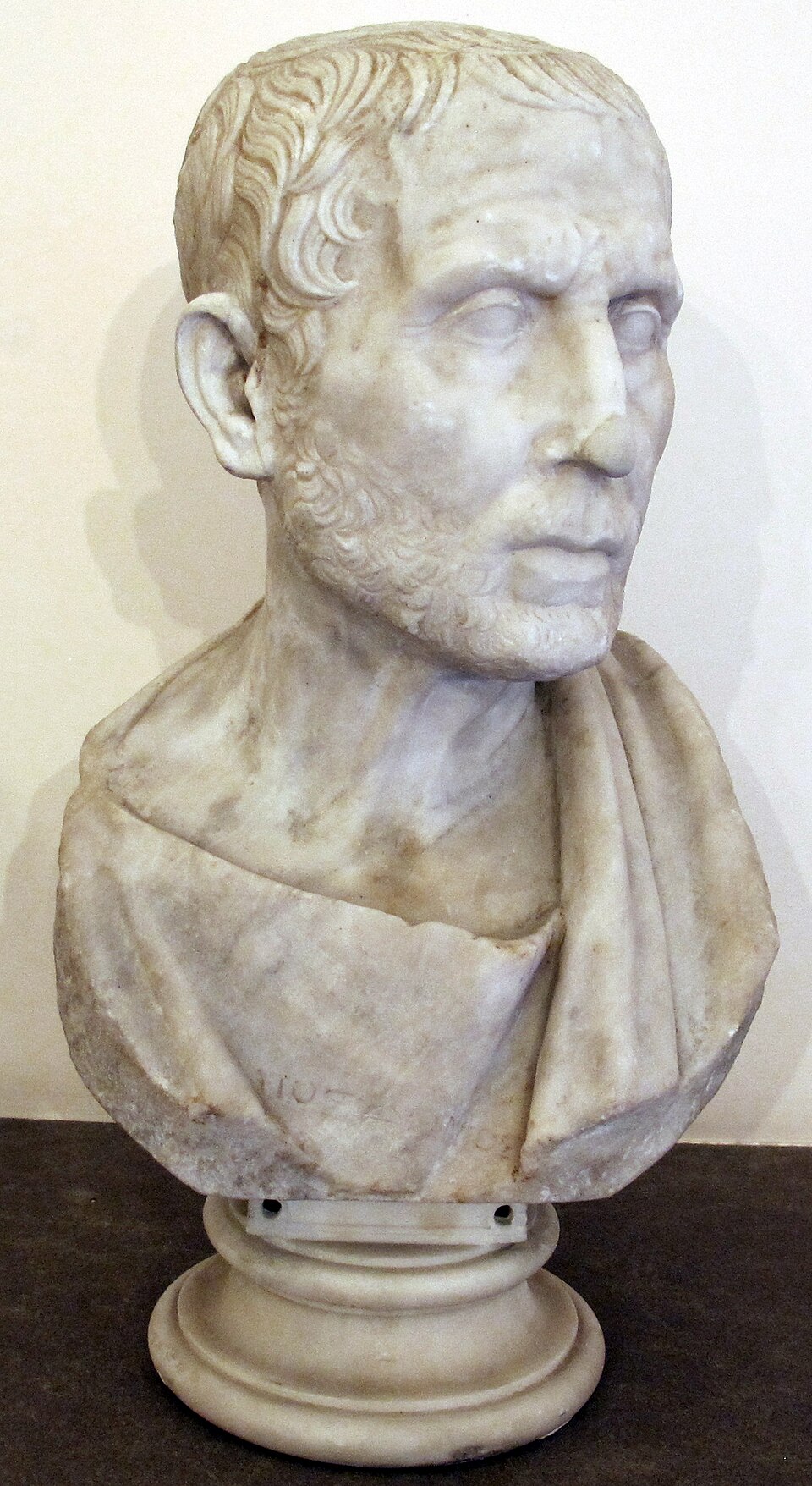
Posidonius also has a securely identified ancient portrait. A marble bust in the National Archaeological Museum in Naples carries an inscription that secures the identification, and the portrait has been dated to about 60 BCE, within his lifetime.
Legacy
Posidonius widened the horizons of Stoicism. He showed that a Stoic could be a working scientist and historian, and his doubts about the Chrysippean theory of the passions opened a debate that scholars still pursue. Through Cicero and Seneca, his ideas reached Roman readers, and through Strabo and Ptolemy, his measurements travelled into later geography.
Where to Start Reading
Begin with Seneca’s Letters 78 and 90, which quote and argue with Posidonius. Strabo’s Geography preserves many of his observations on places and peoples, especially in Books 2 and 3. For his views on the soul, the key source is Galen’s On the Doctrines of Hippocrates and Plato, which is technical but rewarding.
Sources
The quotations on this page come from public-domain translations.
- Seneca, Moral Letters to Lucilius 78.28 and 90, trans. Richard M. Gummere
- Cicero, Tusculan Disputations 2.61 (Pompey’s story of the sickbed lecture; Latin text, The Latin Library)
- Plutarch, Life of Pompey 42.5
- Cicero, On Divination 1.6 and 1.64 (Loeb translation, LacusCurtius)
- Strabo, Geography 2.2.1 to 2.2.2, 3.5.8, 11.1.6, 14.2.13, and 16.2.10 (Loeb translation, LacusCurtius)
- Cleomedes 1.10, trans. T. L. Heath, Greek Astronomy (1932), reprinted in Cohen and Drabkin, A Source Book in Greek Science (1948)
- Galen, On the Doctrines of Hippocrates and Plato, as reported in the modern references below
- Lucian (attributed), Long Lives (Macrobii), as cited in Smith’s Dictionary of Greek and Roman Biography and Mythology (1890), “Poseidonius”
- Stanford Encyclopedia of Philosophy, “Stoicism,” sections 1.1, 1.3, and 4.7
- Internet Encyclopedia of Philosophy, “Stoicism”
- Encyclopaedia Britannica, “Poseidonius,” “Strabo,” “Diodorus Siculus,” “Polybius,” “Ptolemy,” “Cicero,” “Cádiz,” and “Rhodes”
- MacTutor History of Mathematics Archive, “Posidonius of Rhodes”
- T. L. Heath, A History of Greek Mathematics, Vol. 2, p. 221 (the size of the sun)
- M. J. T. Lewis, Surveying Instruments of Greece and Rome (Cambridge University Press) (Ptolemy, Columbus, and the lower figure)
- Bryn Mawr Classical Review 2001.10.38 (review of Richard Sorabji, Emotion and Peace of Mind) and Harvard Center for Hellenic Studies Research Bulletin (Galen’s account of Posidonius)
- Smith’s Dictionary of Greek and Roman Biography and Mythology (1890), “Poseidonius” (Pompey’s visits)
- ancientrome.ru, portrait database, Naples bust of Posidonius (inv. 6142)
- L. Edelstein and I. G. Kidd, Posidonius, Vol. 1: The Fragments (Cambridge University Press, second edition, 1989), and I. G. Kidd, Posidonius, Vol. 2: The Commentary (1988)
- Portrait: bust of Posidonius, Farnese Collection, National Archaeological Museum of Naples. Photo by Sailko, CC BY 3.0, via Wikimedia Commons
- Image: world map after Posidonius, Petrus Bertius and Melchior Tavernier (1628). Public domain, via Wikimedia Commons