In Brief
Zeno of Citium (c. 335 to c. 263 BCE) was the founder of Stoicism. Born in Citium on Cyprus, he came to Athens as a merchant, studied with several philosophers, and, around 300 BCE, began teaching in the Stoa Poikile, the Painted Porch, which gave the school its name. He taught that virtue is the only true good and that the goal of life is to live in agreement with nature.
At a Glance
- Lived
- c. 335 to c. 263 BCE
- Born
- Citium, Cyprus
- Taught in
- Athens, at the Stoa Poikile
- Role
- Founder of the Stoic school
- Teachers
- Crates the Cynic, Stilpo, Polemo
- Students
- Cleanthes, Persaeus, Aristo
- Surviving work
- Fragments only
Almost everything we know about Zeno comes from later writers. None of his books survive whole, and the fullest account of his life is the long chapter that Diogenes Laertius, a Greek biographer of philosophers who flourished in the third century CE, devoted to him in the seventh book of his Lives of the Eminent Philosophers, written some five centuries after Zeno died. That account mixes reliable detail with anecdote, so it is best read as a picture of how the ancient world remembered him rather than as a modern biography.
Early Life and the Shipwreck
Zeno was the son of Mnaseas (some sources say Demeas). According to Demetrius of Magnesia, a writer quoted by Diogenes Laertius, Mnaseas was a merchant who often visited Athens and brought home books about Socrates for his son. Zeno grew up in Citium, a city on the southeast coast of Cyprus, near modern Larnaca, which Encyclopaedia Britannica describes as the principal Phoenician city on the island. The Phoenicians were a seafaring and trading people whose cities lay mainly on the coast of present-day Lebanon. Diogenes Laertius describes Zeno as lean, fairly tall, and swarthy, and he records that Zeno’s teacher Crates once teased him as “my little Phoenician.” Like his father, Zeno worked as a trader. The sources disagree about how old he was when he reached Athens: Diogenes Laertius says he was thirty at the time of his shipwreck, while Persaeus, his student, put his arrival at twenty-two.
The best-known story about him is a shipwreck. According to Diogenes Laertius, Zeno was carrying a cargo of purple from Phoenicia to the Piraeus, the harbour of Athens, when he was shipwrecked. In Athens, he sat in a bookseller’s shop reading the second book of the Memorabilia, Xenophon’s work about Socrates. He was so pleased that he asked where men like Socrates could be found. At that moment, the philosopher Crates passed by, and the bookseller pointed to him and said, “Follow yonder man.” Zeno became his student. He is reported to have looked back on the disaster with a famous line:
I made a prosperous voyage when I suffered shipwreck.
Zeno, quoted in Diogenes Laertius, Lives of the Eminent Philosophers 7.4, trans. R. D. Hicks (1925)
Whether or not every detail is true, the story captures something the Stoics cared about: a loss of property can be the start of a better life, because property was never the good thing in the first place.
Teachers and Influences
Crates was a Cynic. The Cynic movement is usually traced from Antisthenes through Diogenes of Sinope, a philosopher famous for living in poverty, to Crates himself, and its members mocked social conventions and the pursuit of fame and fortune. The Cynics and the Stoics shared the belief that virtue is sufficient for happiness, and Zeno’s later teaching that wealth and reputation are neither good nor bad fits that inheritance. Diogenes Laertius says Zeno was too modest to adopt Cynic shamelessness, and he went on to study with other teachers. These included Stilpo of the Megarian school, a circle of philosophers from Megara, a city neighbouring Athens, who were interested in logic and argument. Diogenes Laertius, citing the writer Timocrates, adds that he attended the lectures of Xenocrates, although Xenocrates died in 314 BCE, around the time Zeno reached Athens. He also studied with Polemo, who succeeded Xenocrates as head of the Academy, the school of Plato’s followers in Athens, and he practised dialectic, the art of argument, with the logician Diodorus Cronus. According to Diogenes Laertius, these teachers taught him for twenty years in all.
This mixture matters. Stoicism did not grow out of a single tradition. It combined Cynic ethics with the careful argument of the logicians and with ideas about nature drawn from earlier thinkers, among them Heraclitus, whose influence on Zeno’s physics Encyclopaedia Britannica notes. Zeno’s achievement was to bring these strands together into one system.
Founding the School at the Painted Porch
Around 300 BCE, Zeno began teaching on his own. He chose a public building, the Stoa Poikile, or Painted Porch, a colonnade at the northern end of the agora, the gathering place for trade and assembly in Athens. It took its name from panel paintings that showed famous battles, including the Battle of Marathon. Diogenes Laertius says Zeno lectured there while pacing up and down. His followers were first called Zenonians, but the name that stuck came from the building: they were the men of the stoa, the Stoics.
Zeno lived frugally, eating small loaves with honey and drinking a little wine, and he was known for his austerity and endurance. “More temperate than Zeno the philosopher” even became a saying. The Athenians honoured him by depositing the keys of the city walls with him and by granting him a golden crown and a bronze statue. They also voted him a public tomb in the Ceramicus, the old potters’ quarter of Athens and an important cemetery. Diogenes Laertius preserves the text of the decree, which praises him for exhorting the young to virtue and temperance and for living in perfect consistency with his own teaching. Zeno, for his part, never denied that he was a citizen of Citium.
What Zeno Taught
According to Diogenes Laertius, Zeno was the first to divide philosophy into three parts, logic, physics, and ethics, in a work called Exposition of Doctrine. The Stoics kept this division and compared philosophy to a fertile field, in which logic is the fence, physics the soil or the trees, and ethics the crop.
Living in Agreement with Nature
Zeno’s formula for the goal of life was to live in agreement with nature. For Chrysippus, the school’s third head, nature meant both human nature and the nature of the whole universe. Reason has been given to human beings as rational animals, so, as Diogenes Laertius puts it, for them life according to reason rightly becomes the natural life, and such a life is the same as a virtuous life. Diogenes Laertius records that Zeno was the first to state this goal, in his treatise On the Nature of Man. Another ancient report, which some modern scholars follow, says that Zeno spoke only of “living in agreement” and that his successor Cleanthes added the words “with nature.”
Virtue as the Only Good
The school Zeno founded held that virtue is the only good and vice the only evil. Everything else, including life, health, wealth, pleasure, pain, and death, is neither good nor bad in itself. The Stoics called these things indifferents. Some are preferred, like health and strength, and some are rejected, like disease and weakness, but a person can be happy without the preferred ones. Happiness, the Stoics said, consists in virtue.
The Republic
Zeno’s most controversial book was his Republic, which Diogenes Laertius says he wrote while still a student of Crates the Cynic. Its critics reported that it banned temples, law courts, and gymnasia, saw no need for coinage, counted only the good as true citizens and friends, and proposed a community of wives. Some later Stoics found it embarrassing. According to one report in Diogenes Laertius, the Stoic Athenodorus cut passages the school disapproved of from copies of Zeno’s works, until he was found out and the passages were restored.
Why None of His Books Survive
Diogenes Laertius lists about twenty titles by Zeno, including works on the passions, on duty, on law, on signs, and on Greek education. All are lost. What remains are short quotations and summaries in later authors, which the scholar Hans von Arnim gathered, with the remains of other early Stoics, in the Stoicorum Veterum Fragmenta (Fragments of the Early Stoics), published from 1903 to 1905. Among the authors who preserve this material are Diogenes Laertius, the Roman statesman and writer Cicero, Plutarch, a Greek biographer and essayist born in 46 CE, and Stobaeus, a collector of excerpts who probably lived in the fifth century CE.
This loss is typical of the early and middle Stoa. No complete work by Zeno, Cleanthes, or Chrysippus survives, and the treatises of the middle Stoa, the period of Panaetius and Posidonius in the second and first centuries BCE, are lost as well. The fullest Stoic works we have come from the Roman period: the writings of Seneca and Marcus Aurelius, and the teachings of Epictetus as recorded by his student Arrian. Seneca, who lived from about 1 BCE to 65 CE, shows how much the later school still felt it owed to its founders while insisting on its own independence:
To Zeno, Cleanthes, Chrysippus, Panaetius, or Posidonius? We Stoics are not subjects of a despot: each of us lays claim to his own freedom.
Seneca, Moral Letters to Lucilius 33.4, trans. Richard M. Gummere
Death and Legacy
Ancient sources disagree about how long Zeno lived. Diogenes Laertius reports one tradition that he died at ninety-eight and another, from his student Persaeus, who also came from Citium, that he died at seventy-two. One story says that he tripped while leaving the school and broke a toe, struck the ground with his fist, quoted the line “I come, I come, why dost thou call for me?”, and died on the spot by holding his breath. Another says he stopped eating. The details cannot be checked. Encyclopaedia Britannica dates his death, in Athens, to about 263 BCE.
His school long outlived him. Cleanthes succeeded him as head, Chrysippus became its foremost theorist and systematizer, and the tradition continued into the age of Seneca, the former slave Epictetus, and Marcus Aurelius, who ruled as Roman emperor from 161 to 180 CE. Whenever a modern reader talks about focusing on what is up to us, treating virtue as the measure of a good life, or seeing hardship as a test rather than a disaster, they are drawing on a tradition Zeno started in a public colonnade in Athens.
Where to Start Reading
Because Zeno’s own works are lost, the best way to meet him is through the ancient account of his life. Book 7 of Diogenes Laertius begins with a long chapter on Zeno and then summarizes Stoic teaching as a whole. In Book 3 of Cicero’s dialogue On Ends, the speaker Cato sets out Stoic ethics, and in Book 4, Cicero answers him with criticisms. After that, the surviving Roman Stoics show how Zeno’s ideas were lived out in practice.
Sources
The quotations on this page come from public-domain translations.
- Diogenes Laertius, Lives of the Eminent Philosophers 7.1 to 7.7, 7.10 to 7.13, 7.25 to 7.28, 7.31 to 7.37, 7.39 to 7.40, 7.86 to 7.89, 7.101 to 7.106, trans. R. D. Hicks (1925, LacusCurtius and Perseus)
- Diogenes Laertius, Lives of the Eminent Philosophers 4.16 (Polemo)
- Seneca, Moral Letters to Lucilius 33.4, trans. Richard M. Gummere (Standard Ebooks)
- Cicero, On Ends, Books 3 and 4
- Stanford Encyclopedia of Philosophy, “Stoicism” (Dirk Baltzly), “Seneca”, “Epictetus”, and “Marcus Aurelius”
- Internet Encyclopedia of Philosophy, “Cynics” and “Stoa Poikile”
- Encyclopaedia Britannica, “Zeno of Citium”, “Citium”, “Xenocrates”, “Epictetus”, “Diogenes Laertius”, “Cicero”, “Plutarch”, and “Megara”
- William Smith, Dictionary of Greek and Roman Biography and Mythology, “Polemon”
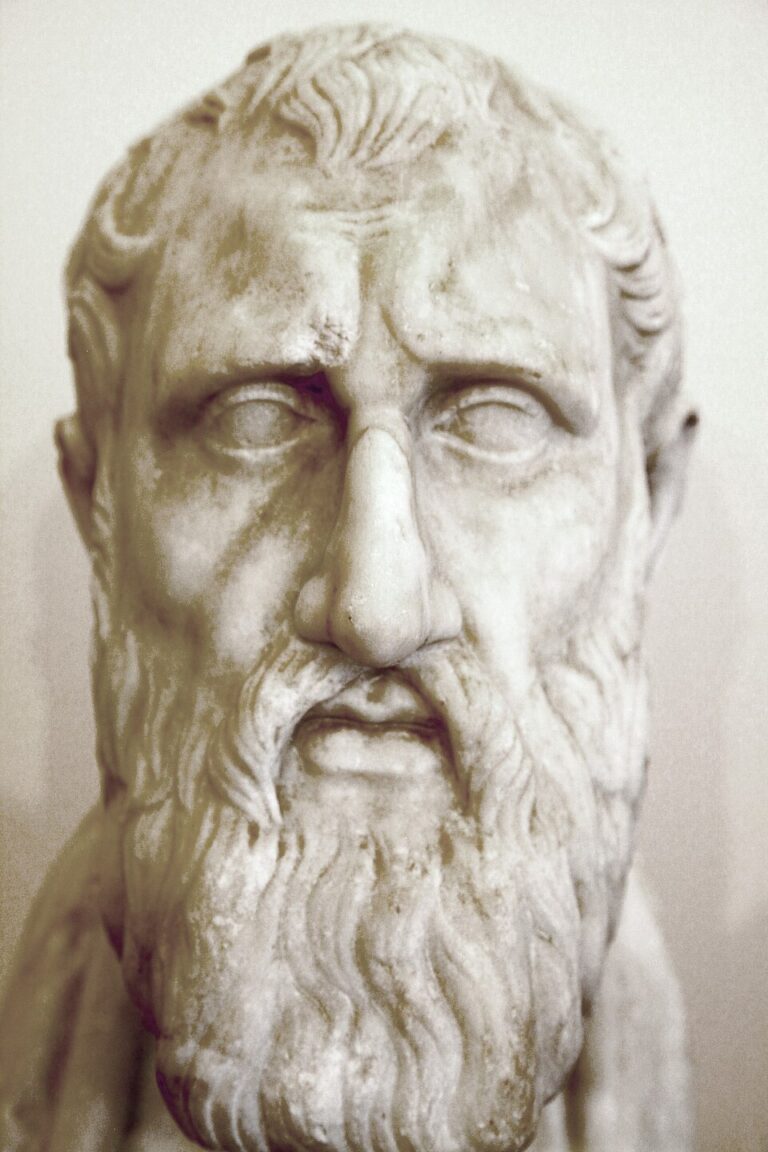
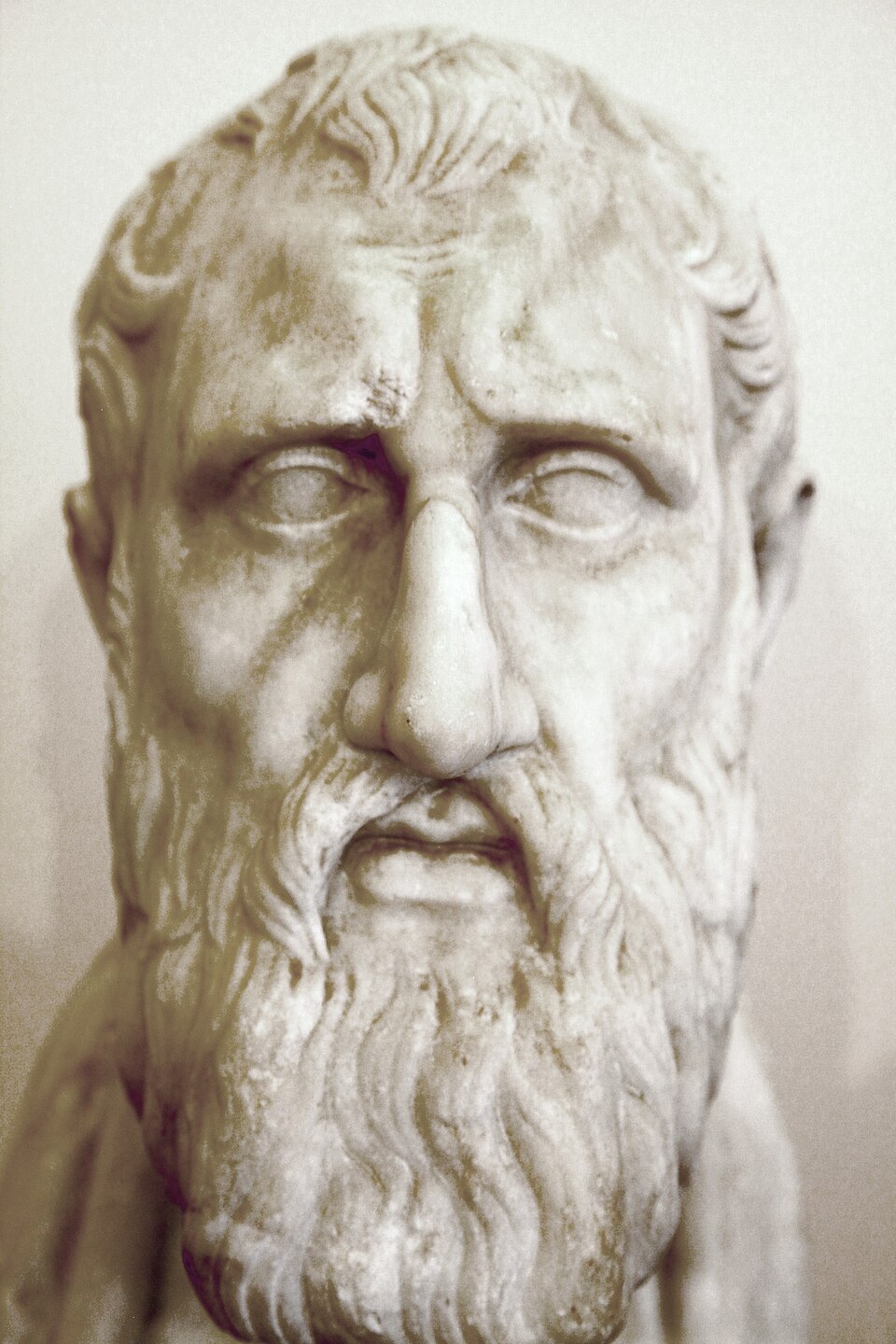
- Portrait: marble bust of Zeno of Citium, Farnese Collection, National Archaeological Museum of Naples. Photo by Jeremy Weate, CC BY 2.0, via Wikimedia Commons
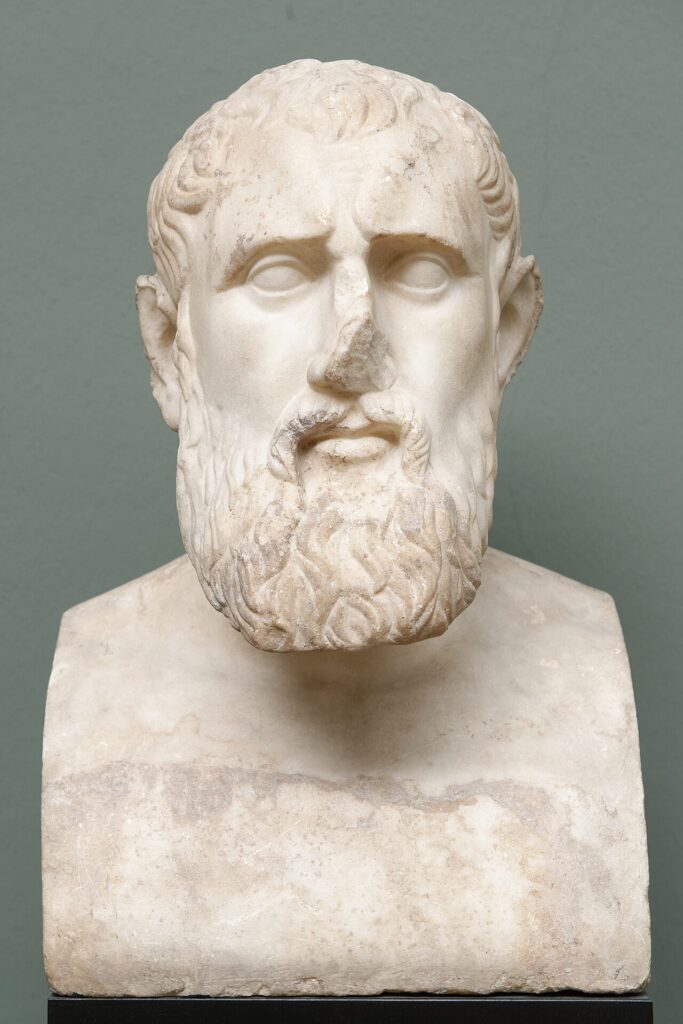
- Image: bust of Zeno of Citium, Ny Carlsberg Glyptotek, Copenhagen. Photo by Marie-Lan Nguyen, public domain, via Wikimedia Commons