In Brief
Panaetius of Rhodes (c. 185 to 109 BCE) was a Stoic philosopher who helped carry Stoicism into Roman public life. He spent many years in Rome as a friend of the Roman general Scipio Aemilianus and later became head of the Stoic school in Athens. His book on appropriate action is lost, but it was the main source for the first two books of On Duties by the Roman statesman Cicero. That work later became one of the first classical books ever printed.
At a Glance
- Lived
- c. 185 to 109 BCE
- Born
- Rhodes
- Head of the school
- c. 129 to 109 BCE
- Period
- Middle Stoa
- Teachers
- Diogenes of Babylon, Antipater of Tarsus
- Students
- Posidonius, Hecato
- Surviving work
- Fragments only
Historians place Panaetius, together with his student Posidonius, in the middle Stoa, a label for the Stoicism of the second and first centuries BCE, although some scholars question how useful the label is. In the words of Britannica, he tempered the rigid austerity of the early school, and, as Seneca’s account of his advice to a young man shows, he spoke more to ordinary people still far from wisdom than to the perfect sage. Through Cicero, who borrowed heavily from him, those ideas reached readers for centuries.
Life
Panaetius, the son of Nicagoras, was born on Rhodes, an island in the southeastern Aegean Sea near the southwest coast of modern Turkey, into an old and eminent Rhodian family. His exact birth year is unknown: the Oxford Classical Dictionary gives about 185 BCE, while Britannica gives about 180 BCE. He went to Athens to study with Diogenes of Babylon, then head of the Stoic school, and with Diogenes’s successor, Antipater of Tarsus.
In Rome, he became a friend of Scipio Aemilianus, probably through Gaius Laelius, and he joined Scipio’s circle, which also included Polybius, a Greek statesman and historian who wrote about the rise of Rome. Scipio was the general who commanded the final Roman siege of Carthage, the North African city that Rome destroyed in 146 BCE. Around 140 BCE, according to Britannica, Panaetius was Scipio’s only companion on an embassy to the East, which Smith’s Dictionary describes as a mission to the kings of Egypt and Asia, and Plutarch also says that Scipio took a single friend, Panaetius, on the journey. Reference works date the embassy differently, from about 144 BCE in Smith’s nineteenth-century Dictionary to 140 BCE in Britannica, and some modern scholars place it in 139 or 138 BCE.
Panaetius lived in Rome for many years and taught Romans there. Cicero names Publius Rutilius Rufus as one of those who heard him, and he says that the Stoic Marcus Vigellius lived with him.
When Antipater died, around 129 BCE, the same year as Scipio, Panaetius succeeded him as head of the Stoic school in Athens. Britannica says that he spent the last twenty years of his life in Athens, and he died there around 109 BCE.
On Appropriate Action
Panaetius’s most influential book, known in English as On Appropriate Action or On the Appropriate, dealt with what the Stoics called kathēkon. Diogenes Laertius, in his Lives of the Eminent Philosophers, says that Zeno, the founder of the school, was the first to use the term this way, and he defines it as an action for which a reasonable defence can be given once it is done. Latin writers rendered it officium, usually translated as duty. Several Greek Stoics wrote books on proper functions, but Panaetius’s was the one Cicero chose to follow, and it gave Stoic ethics a more practical turn.
The book is lost, but we know a good deal about it because Cicero used it as the basis for his own treatise On Duties, written in 44 BCE as a letter to his son, who was then studying philosophy in Athens. Cicero says so openly:
Panaetius, then, has given us what is unquestionably the most thorough discussion of moral duties that we have, and I have followed him in the main
Cicero, On Duties 3.7, trans. Walter Miller (1913)
Cicero adds that he made slight modifications of his own. He explains that Panaetius divided his subject into three questions: what is morally right, what is useful, and how to decide when the two seem to conflict. Panaetius treated the first two but never wrote the third, even though, according to his student Posidonius, he lived for thirty years after publishing the work. Walter Miller, who translated On Duties in 1913, judged that Cicero follows Panaetius more or less closely in Books 1 and 2, while Book 3, on conflicts between what is right and what is useful, is more independent.
What Panaetius Taught
Panaetius kept the core of Stoic ethics but changed its emphasis. Four ideas show how he adapted the school for people living ordinary public lives.
Ethics for Those Making Progress
The Stoics divided people into the wise and the ignorant, and they held that knowledge, and therefore virtue, was found only in the sage, the perfectly wise person. Panaetius did not deny the distinction, but he was more interested in the people on the near side of it. Seneca reports that when a young man asked him whether the wise man would fall in love, Panaetius replied that the wise man could wait. The two of them, he said, still far from wisdom, should avoid a passion that would leave them disturbed, out of control, and dependent on another person. His ethics speaks to those making progress, which is to say almost everyone.
The Four Roles
One of the ideas traditionally attributed to Panaetius, although Cicero does not name him at this point, is that each person plays several roles at once. Cicero describes four. Nature gives us two of them: the first is our shared human nature as rational beings, and the second is our individual character and talents. The third is imposed by chance or circumstance, such as birth, wealth, or political office. The fourth is the path in life we choose for ourselves, and Cicero gives philosophy, civil law, and oratory as examples. Acting well means taking all four into account, so that what is right for one person may not be right for another.
The Four Virtues
Book 1 of On Duties, the part that Miller thought follows Panaetius closely, is organized around four sources of moral rightness: wisdom, justice, greatness of spirit, and moderation. Within it, Cicero gives particular attention to propriety, which the Latin calls decorum and the Greek prepon, the sense of what is fitting in word and deed. He argues that propriety cannot be separated from moral goodness.
Departures from Earlier Stoics
Panaetius was willing to question parts of the inherited system. According to Diogenes Laertius, he held that the world is imperishable, and the Stanford Encyclopedia of Philosophy notes that he rejected the Stoic doctrine that the universe is periodically consumed by fire and then renewed. Cicero reports that, although Panaetius did not dare to say that divination had no force, he declared himself in doubt about it, and that he was the only one of the Stoics to reject the predictions of astrologers. He also studied Plato and Aristotle, and the Internet Encyclopedia of Philosophy describes the broader project he shared with Posidonius as one of seeking common ground with other schools.
Students and Influence
Panaetius’s most famous student was Posidonius, who went on to teach on Rhodes and became a friend of Cicero. Another student, Hecato of Rhodes, wrote books on duty dedicated to Quintus Tubero, according to Cicero, and he is quoted in several letters of Seneca, the Roman Stoic writer, including Letters 5, 6, and 9. Cicero also reports that Rutilius Rufus, another pupil, compared the unfinished third part of Panaetius’s book to an unfinished painting of Venus by the painter Apelles, which no later artist dared to complete.
Legacy
Panaetius’s direct influence ended with the loss of his books, but his indirect influence was large. Miller notes that On Duties may have been the first classical book ever issued from a printing press, appearing in 1465. Ambrose of Milan, a Christian saint of the fourth century, wrote his own book On Duties, and in the sixteenth and seventeenth centuries, Cicero’s work was one of the books most often studied in English schools, and at Eton, the senior boys heard readings from it. Frederick the Great, king of Prussia, called it the best work on morals that has been or can be written. Through it, readers learned Panaetius’s Stoicism without always knowing his name.
Where to Start Reading
Read Books 1 and 2 of Cicero’s On Duties, which preserve Panaetius’s thinking more fully than any other source. The opening sections of Book 3 explain how Cicero used his work. Walter Miller’s 1913 translation is in the public domain and freely available.
Sources
The quotations on this page come from public-domain translations.
- Cicero, On Duties (De Officiis) 1.1, 1.15, 1.93 to 1.94, 1.107, 1.115, 3.7 to 3.10, and 3.63, trans. Walter Miller (Loeb, 1913), with Miller’s introduction
- Cicero, On Divination 1.6 and 2.88 (Loeb translation, LacusCurtius)
- Cicero, On Ends 4.79; On the Orator 3.78; Brutus 114
- Seneca, Moral Letters to Lucilius 116.5, and Letters 5, 6, and 9 (Hecato)
- Diogenes Laertius, Lives of the Eminent Philosophers 7.107 to 7.108 and 7.142, trans. R. D. Hicks (1925)
- Strabo, Geography 14.2.13 (his Rhodian family)
- Plutarch, Sayings of Romans, Scipio the Younger 13 to 14 (Moralia 200E to 201A, attalus.org)
- Stanford Encyclopedia of Philosophy, “Stoicism,” sections 1.1, 2.5, 3.7, 4.2, and 4.4
- Internet Encyclopedia of Philosophy, “Stoicism”
- Encyclopaedia Britannica, “Panaetius,” “Polybius,” “Third Punic War,” and “Rhodes”
- Nicene and Post-Nicene Fathers, introduction to Ambrose’s On Duties (CCEL)
- J. Clare, on De Officiis in early modern English schools, Ciceroniana On Line 4.2 (2020)
- Smith’s Dictionary of Greek and Roman Biography and Mythology (1890), “Panaetius”
- Suda On Line, entry pi 184 (Panaetius), with notes citing the Oxford Classical Dictionary
- J. L. Ponce Pérez, “The Philosophy of Panaetius of Rhodes Revisited in Light of the Theory of the Four Persons,” Ciceroniana On Line 9 (2025)
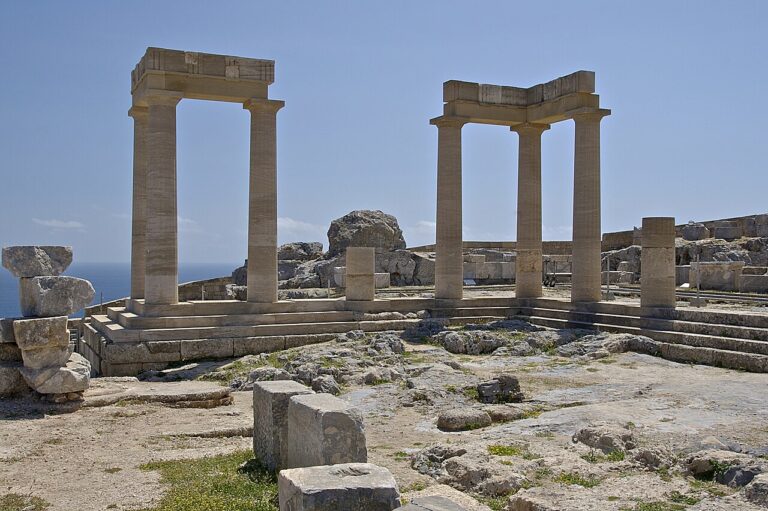
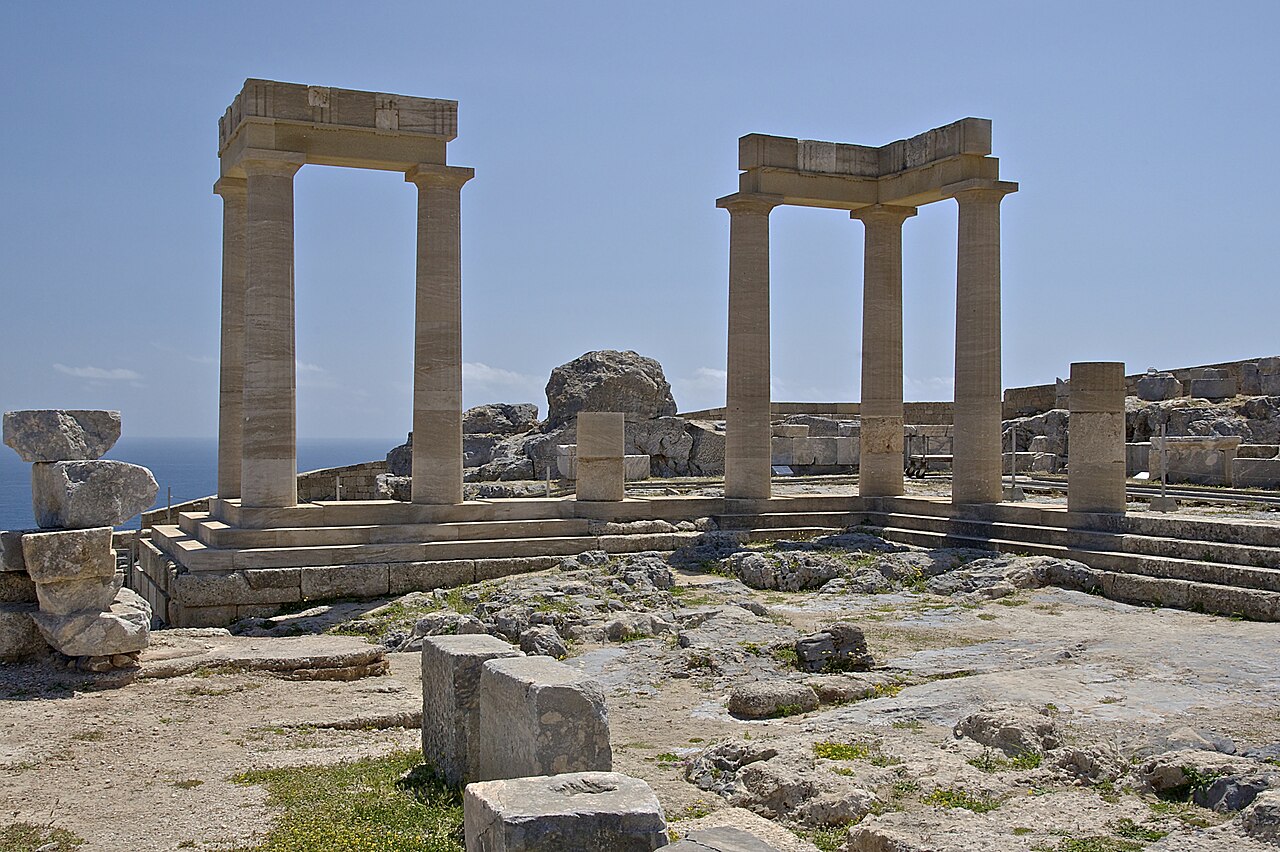
- Title image: portico of the temple of Athena Lindia, acropolis of Lindos, Rhodes. Photo by Jebulon, CC0, via Wikimedia Commons