In Brief
Lucius Annaeus Seneca (c. 4 BCE to 65 CE) was a Roman statesman, writer, and Stoic philosopher. He served for years as tutor and adviser to the emperor Nero and became one of the wealthiest men of his time. His Moral Letters to Lucilius, written late in his life, are, together with the works of Epictetus and Marcus Aurelius, among the fullest Stoic writings to survive. In 65 CE, Nero ordered him to take his own life.
At a Glance
- Lived
- c. 4 BCE to 65 CE
- Born
- Corduba, Spain (modern Córdoba)
- Career
- Senator, tutor and adviser to Nero
- Period
- Roman Stoa
- Teachers
- Attalus the Stoic, Sotion, Papirius Fabianus
- Main works
- Moral Letters to Lucilius, essays, Natural Questions, tragedies
- Surviving work
- Extensive
Seneca is the Stoic whose life most clearly tested his philosophy. He held a vast fortune while praising the philosopher’s freedom from wealth, wrote about tranquility while serving a dangerous emperor, and wrote about death in a way that his own death seemed to confirm. Even in his lifetime, a critic charged that he talked more bravely than he lived, and the Internet Encyclopedia of Philosophy calls him one of the most controversial Stoic figures. Some readers see a hypocrite. Others see a man who knew how far he fell short and wrote to help himself and others do better.
Early Life and Career
Seneca was born in Corduba, modern Córdoba, in Roman Spain. His birth year is uncertain: the Internet Encyclopedia of Philosophy gives about 4 BCE as the most common estimate and places it between 8 and 1 BCE, while the Stanford Encyclopedia of Philosophy gives about 1 BCE. His father, Seneca the Elder, was a Roman knight from Corduba who wrote about rhetoric. Seneca was taken to Rome as a small child, probably at about the age of five, and was educated there in rhetoric and philosophy.
Among his teachers were the Stoic Attalus, whose classroom, he says, he practically besieged, and the philosopher Sotion, who persuaded him to give up meat. Seneca kept to the diet for more than a year and came to enjoy it, but he returned to his former habits at the request of his father, who, he says, hated philosophy. He suffered from attacks of breathlessness, which he describes in Letter 54, and he spent a long period of ill health in Egypt, where his aunt’s husband was the Roman prefect.
With his aunt’s help, he was elected quaestor, the lowest-ranking regular Roman magistracy, an office whose holders entered the Senate, some time after his return from Egypt. The historian Cassius Dio reports that the emperor Caligula, jealous of a speech Seneca made in the Senate, ordered him to be put to death, and that he spared him only because a woman close to him said Seneca was so ill with consumption that he would soon die anyway. In 41 CE, the emperor Claudius exiled him to the island of Corsica on a charge of adultery with Julia Livilla, the sister of Caligula, although the evidence was not decisive. He remained there until 49 CE and wrote consolations, essays meant to comfort someone in grief or misfortune. One, written to his mother, Helvia, during the exile, comforts her for his absence, and some scholars think it may also have been meant as a plea for his recall.
Nero’s Adviser
In 49 CE, Agrippina, who had just married her uncle, Claudius, had Seneca recalled to Rome and appointed him tutor to her son, Nero. When Nero became emperor in 54 CE, still in his teens, Seneca and Burrus became his chief advisers. Burrus was the praetorian prefect, commander of the emperor’s guard, and Tacitus contrasts his soldierly austerity with Seneca’s lessons in eloquence. Some ancient sources credit Seneca with the good policies of the early reign. During these years, probably in 55 or 56 CE, he wrote On Mercy, addressed to Nero, which urges the emperor to show mercy as a ruler.
The partnership did not last. In 59 CE, Nero had his mother, Agrippina, murdered. Tacitus, in his Annals, reports that Nero summoned Seneca and Burrus during the crisis, and that blame afterward fell on Seneca for composing the letter in which Nero justified the killing to the Senate. After Burrus died in 62 CE, Seneca’s influence declined rapidly. Tacitus describes him asking Nero for leave to retire and offering to give back the wealth the emperor had given him. Nero refused, and Seneca withdrew from public life as far as he could, rarely appearing in the city.
Wealth and Its Critics
Seneca’s fortune was enormous. Around 58 CE, Publius Suillius Rufus accused him of amassing three hundred million sesterces, partly through lending, although Tacitus, who reports the attack, presents Suillius as a deeply hostile witness. The later historian Cassius Dio even named Seneca’s loans, called in all at once, as one cause of the uprising of Boudica in Britain. Seneca answered such critics in his essay On the Happy Life. There, he argues that the wise man does not love riches but prefers to have them, receiving them into his house but not into his soul, and he admits openly that he is not a wise man. Whether that answer satisfies is still debated. What is clear is that Seneca never pretended to be the perfect sage.
The Letters to Lucilius
In retirement, between about 62 and 65 CE, Seneca wrote letters to his friend Lucilius, a Roman official then serving in Sicily as procurator. The 124 surviving letters are divided into twenty books. They are written as personal correspondence, and scholars still debate how far Lucilius was their real audience. Each letter takes up a theme, such as friendship, illness, or fear, and works through it with practical advice, often quoting a saying from another thinker.
The very first letter sets the tone:
Nothing, Lucilius, is ours, except time.
Seneca, Moral Letters to Lucilius 1.3, trans. Richard M. Gummere
Seneca’s style is quotable, direct, and personal. He freely cites Epicurus, the founder of the rival Epicurean school, when he finds something useful, explaining in Letter 2 that he crosses into the enemy’s camp not as a deserter but as a scout. He writes as a fellow student rather than a master. In Letter 13, on groundless fears, he writes:
There are more things, Lucilius, likely to frighten us than there are to crush us; we suffer more often in imagination than in reality.
Seneca, Moral Letters to Lucilius 13.4, trans. Richard M. Gummere
The Essays and Other Works
Seneca’s other prose works are usually called the Dialogues, a traditional title for a collection of twelve books making up ten works, and many of them are addressed to a friend or relative. Among them are On the Shortness of Life, which argues that life is short and should not be wasted on trivial pursuits; On Anger, in three books, which aims to help readers avoid becoming angry; On Providence, dedicated to Lucilius, which treats misfortunes as tests that strengthen virtue; and On the Happy Life, addressed to his older brother, Gallio. He also wrote Natural Questions, a study of natural phenomena, such as lightning, earthquakes, and comets, in eight books, and tragedies, of which eight survive. Among them is Thyestes, and his plays strongly influenced tragic drama in Elizabethan England and in France.
Death
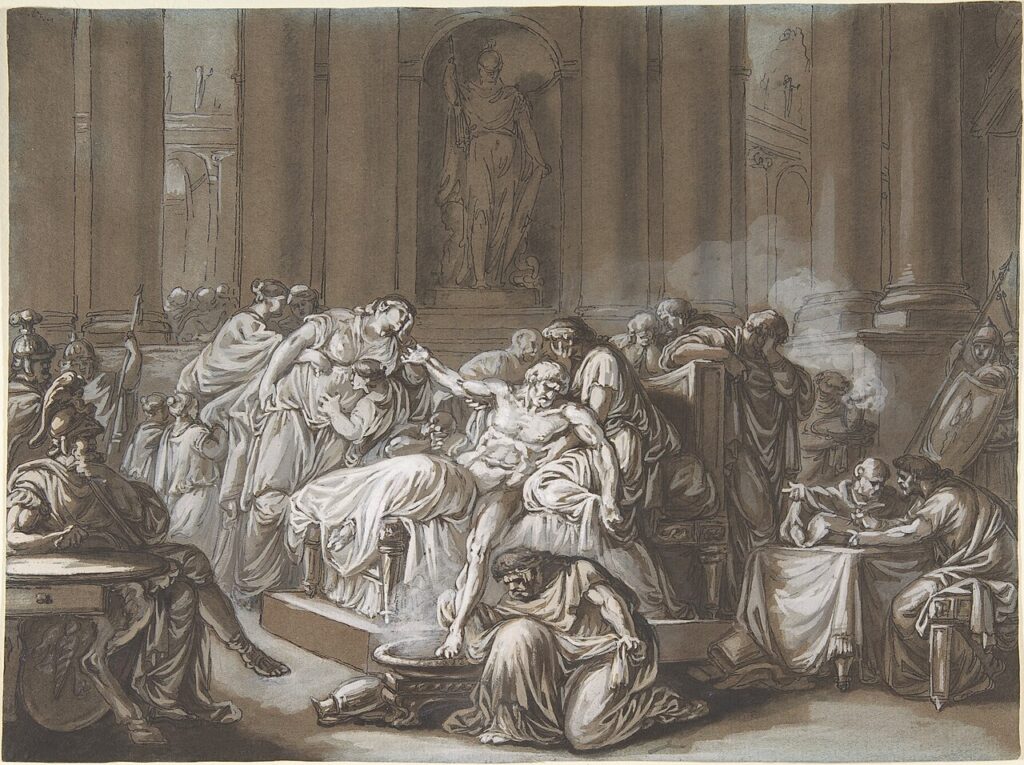
In 65 CE, a conspiracy to assassinate Nero, centred on the senator Gaius Calpurnius Piso, was discovered. The evidence against Seneca was thin, and historians still disagree about whether he knew of the plot, although Tacitus reports a rumour that some plotters meant to hand the empire to him. Nero used the opportunity to order his death. Tacitus describes the scene in Book 15 of his Annals. Seneca, denied the tablets to make his will, told his friends that he would leave them the one thing he still had, the image of his life. He opened the veins in his arms and, because his aged body bled slowly, those in his legs as well. When death still did not come, he took poison of the kind used to execute condemned prisoners at Athens, and he was finally carried into a bath, where he suffocated in the steam. His wife, Pompeia Paulina, tried to die with him, but Nero ordered that her death be prevented, and her slaves bound up her arms.
Portraits
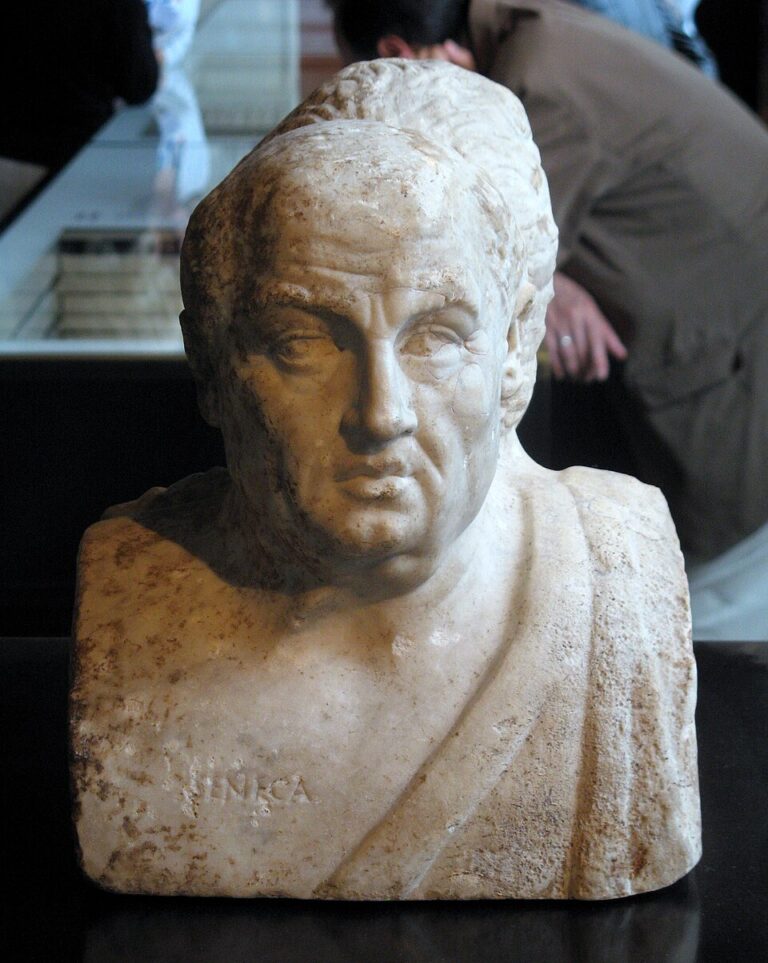
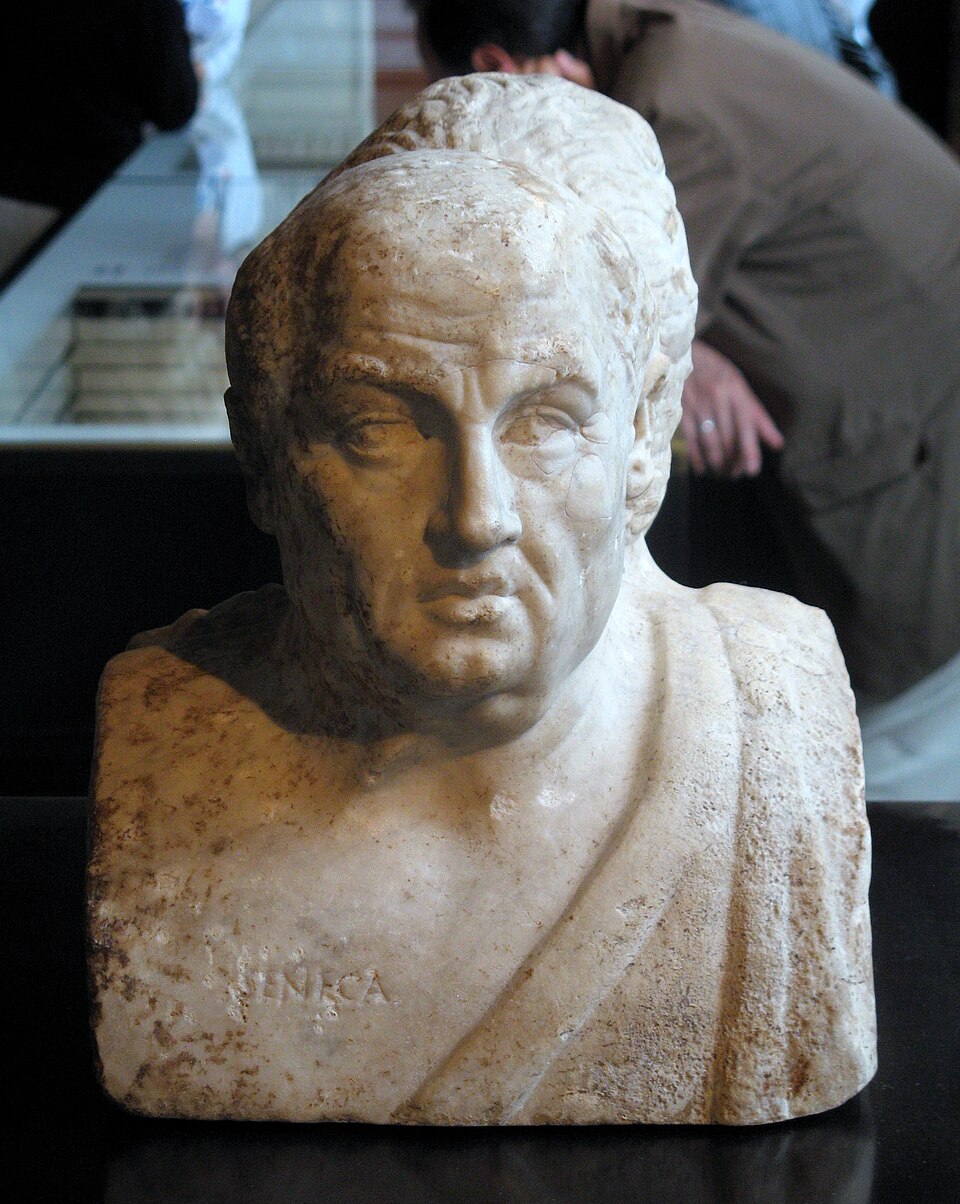
The portrait accepted as Seneca is a double herm, a two-headed portrait that pairs him with Socrates, in the Antikensammlung, the collection of ancient sculpture in Berlin. Dated to the first half of the third century CE, it bears Seneca’s name. A famous bearded head long reproduced as Seneca, now called the Pseudo-Seneca, was identified as him from 1598 until 1813, when the inscribed portrait now in Berlin was found and showed a quite different face. Who the Pseudo-Seneca represents remains unknown.
Legacy
Seneca’s works were well received by Christian thinkers in the early Middle Ages, partly because of a forged exchange of letters between him and the apostle Paul, created by the fourth century and long thought genuine. For medieval readers who no longer knew Greek, he was for a long time one of only a few sources for Stoic philosophy. During and after the Renaissance, his works continued to be read widely, and Michel de Montaigne gave a spirited defence of him in his Essays. Interest has not faded: two new biographies of Seneca appeared in 2014, and a recent translation by Margaret Graver and A. A. Long was, according to its publisher, the first complete English translation of the Letters in nearly a century.
Where to Start Reading
Start with the Letters to Lucilius, reading the first twenty in order before dipping into later ones by theme. Then read On the Shortness of Life, which is short and widely available. For his death and its political context, read Tacitus, Annals 15.60 to 15.64.
Sources
The quotations on this page come from public-domain translations.
- Seneca, Moral Letters to Lucilius 1.3, 2, 13.4, 54.1, and 108.3 and 108.17 to 108.22, trans. Richard M. Gummere
- Seneca, On the Happy Life 17.3, 18.1, and 21.4, trans. Aubrey Stewart (1900)
- Seneca, To Helvia 19.2
- Tacitus, Annals 12.8, 12.42, 13.2, 13.6, 13.42, 14.7, 14.11, 14.51 to 14.56, 15.48, and 15.60 to 15.65 (Loeb translation, LacusCurtius)
- Cassius Dio, Roman History 59.19, 60.8.5, 61.4, 61.10, and 62.2.1 (Loeb translation, LacusCurtius)
- Jerome, On Illustrious Men 12 (the forged letters with Paul)
- Montaigne, Essays 2.32, “A Defence of Seneca and Plutarch”
- Stanford Encyclopedia of Philosophy, “Seneca” and “Stoicism,” section 1.3
- Internet Encyclopedia of Philosophy, “Seneca” and “Stoicism”
- Encyclopaedia Britannica, “Quaestor” and “Senecan tragedy”
- Harper’s Dictionary of Classical Antiquities, “Seneca” (on his father)
- University of Chicago Press, description of Seneca, Letters on Ethics, trans. Margaret Graver and A. A. Long (MIT Press Bookstore listing)
- ancientrome.ru, portrait database, double herm of Socrates and Seneca
- Sapere (De Agostini), “Dialoghi” of Seneca (descriptions of the Dialogues)
- Museum of Classical Archaeology, University of Cambridge, cast record for the Pseudo-Seneca head
- Gipsformerei der Staatlichen Museen zu Berlin, “Socrates and Seneca, Double Herm”
- Portrait: Seneca’s side of the double herm of Socrates and Seneca, Antikensammlung, Berlin. Photo by Mark Landon, CC BY 4.0, via Wikimedia Commons
- Image: Jean Guillaume Moitte, The Death of Seneca, Metropolitan Museum of Art, New York. CC0, via Wikimedia Commons